Showing posts with label Cliviger. Show all posts

Friday, 12 December 2025

Unearthing the Lost Charms of Holme Railway Station

The landscape of Lancashire is etched with stories, and for those who know where to look, whispers of a bygone era can still be heard, carried on the wind through forgotten valleys. Today, we're taking a journey back in time, inspired by a captivating image of Holme Railway Station, a quaint stop that once served the rural communities of Holme Chapel and Cliviger, nestled near the bustling town of Burnley.

Looking at this sepia-toned photograph, one can almost hear the chuffing of a steam engine, the clang of the signal box, and the murmurs of passengers awaiting their connection. Holme Railway Station, though now lost to the annals of history, represents a crucial link in the daily lives of the people it served. Imagine the workers commuting to Burnley, the children heading to school, or families embarking on a rare excursion – all dependent on this vital thread of the railway network.

Opened in the mid-19th century, Holme Station was part of the Lancashire and Yorkshire Railway's Todmorden to Burnley line. It wasn't a grand terminus, but rather a humble yet essential outpost. The image perfectly captures this essence: a small station building, perhaps a waiting room, and the distinctive signal box, a solitary sentinel overseeing the tracks as they snaked through the undulating terrain. The surrounding hills, still wild and untamed, remind us of the challenging landscape through which these early railways were carved.

The station's existence speaks volumes about the ambition and engineering prowess of the Victorian era, transforming isolated hamlets into accessible points on a wider map. For Holme Chapel and Cliviger, the railway brought connectivity, trade, and a connection to the burgeoning industrial heartlands of Lancashire. It facilitated the movement of goods, from local agricultural produce to coal from nearby mines, and significantly impacted the local economy and social fabric.

As the 20th century progressed, changes in transport, particularly the rise of road networks, began to challenge the viability of many rural railway lines. Holme Railway Station, like so many others, eventually succumbed to these shifts, closing its doors to passengers in the mid-1950s and freight a few years later. Today, the station buildings are long gone, replaced by overgrown embankments or repurposed pathways.

Yet, images like this one serve as powerful reminders of what once was. They invite us to reflect on the immense impact of the railway age, not just on grand cities, but on the quiet corners of the countryside. They prompt us to consider the stories held within these forgotten structures – the welcomes and goodbyes, the dreams and daily routines that unfolded on their platforms.

So, next time you're exploring the footpaths and byways around Holme Chapel or Cliviger, take a moment. Pause. And if you listen closely, you might just hear the faint echo of a whistle, a phantom train passing through the valley, carrying with it the memories of Holme Railway Station.

This captivating photograph comes from my personal collection. Unfortunately, the original photographer's identity remains a mystery. If anyone knows I will be happy to credit them.

Please take a moment to share this post, follow me on social media and explore my work on Clickasnap and Photo4Me suing the links below. Your support means a lot!


Sunday, 31 August 2025

Exploring St. John the Divine: A Historic Gem in the Cliviger Valley

Tucked away in the scenic Cliviger valley, on the outskirts of Burnley, lies the beautiful and historic Church of St. John the Divine. This Grade II listed building is a testament to history, with a fascinating story that dates back to the 18th century, and even earlier.

A New Beginning on Ancient Ground

The current church was consecrated in 1794, but its history is much older. It stands on higher ground, a short distance from the site of an earlier, more rustic chapel that had served the community since the reign of King Henry VIII. When the original chapel became too dilapidated and small for the growing parish, it was demolished in 1788 to make way for the new structure. The new church, built in a simple classical style with squared sandstone, was largely funded by Dr. T. D. Whitaker, a local landowner and historian from the nearby Holme Hall.

Architectural Highlights and Hidden Treasures

The church's architecture is a striking departure from the more common Gothic style found in many English parishes. Its clean, classical lines, a pedimented entrance, and a bell turret topped with an octagonal cupola give it a unique and elegant character. But the real treasures are found both inside and out. The churchyard itself is a peaceful and beautiful space, with a winding path leading through a sea of old headstones and memorials.

One of the most notable features of the churchyard is the burial site of General Sir James Yorke Scarlett, the celebrated leader of the Charge of the Heavy Brigade during the Battle of Balaclava in the Crimean War. Despite his fame, Scarlett's grave is a humble memorial in this quiet corner of Lancashire. The church also houses remnants of its past, including a 16th-century oak pulpit and two intricately carved oak stalls with misericords, believed to have been moved here from the ruins of Whalley Abbey.

Another interesting detail is the large archway at the entrance, a lychgate, which stands as a welcoming portal to this historic site. Nearby, you'll find a war memorial in the shape of a cross, a poignant tribute to local lives lost in conflict. The church and its grounds are a peaceful place, where history, nature, and community intertwine, making it a compelling spot for a quiet stroll and a moment of reflection.

I took these pictures on the 23rd April 2016 with a Nikon d3300, clicking on any of them should open a link in another window to my Colin Green Photography store on Zazzle.


Please take a moment to share this post, follow me on social media, and explore my work on Clickasnap and Photo4Me using the links below. Your support means a lot!


All the pictures remain the copyright of Colin Green.

Saturday, 30 June 2018

Holme & Cliviger: Gorge, Church, and Landscape

On a crisp April day in 2016, the 23rd to be precise, my trusty Nikon D3300 and I set out to explore the rugged beauty surrounding Holme and Cliviger. My primary mission? To finally capture the stoic grandeur of St. John the Divine, a landmark I'd admired countless times in passing. Little did I know, the day held far more treasures than just a church portrait. The walk unfolded into a delightful adventure, revealing the hidden wonders of the landscape: the shadowy maw of Holme Tunnel, the elegant span of Buckley Bridges, and a tapestry of other captivating scenes.

Holme Tunnel itself, a subterranean passage slicing beneath the dramatic Thieveley Scout, part of the Cliviger Gorge, proved a highlight. This 265-yard marvel, born in 1849, whispered tales of a bygone era. I learned that it had recently emerged from a transformative £11.5 million refurbishment, shedding its slow, 20mph crawl for the exhilarating rush of 75mph. A testament to engineering prowess, it stood as a powerful reminder of the region's enduring spirit.

Clicking any of the images below should open a link in another window to my Colin Green Photography store on Zazzle.


Buckley Bridge.
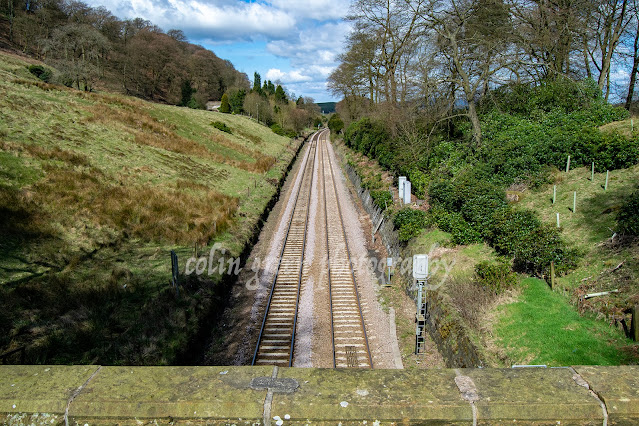
The Copy Pit Railway Line traverses the landscape via Buckley Bridge, a primary structure. Adjacent, to the west, a secondary bridge spans the road, its function less immediately apparent. Oral tradition suggests this smaller bridge was integral to the original Holme Railway Station approach, a detail that hints at a more complex history than the present-day scene reveals.


Below are a couple of views taken from near the top of Cliviger Gorge looking towrads Todmorden with Stoodley Pike Visible in the distance and across the valley towards the Church of St John the Devine.


The Church of St John the Devine.
Consecrated between 1788 and 1794, this active Anglican church, a Grade II listed landmark in the Blackburn diocese, gazes down upon the village like a silent guardian. But it's more than just stones and mortar; it's a place where stories reside. General Sir James Yorke Scarlett, a name etched in Crimean War history for his daring charge, found his final peace here. The sheer scale of his funeral, with over 60,000 people lining the streets, speaks volumes about the man, and the impact of his life.


Thanks for looking, please take a moment to share and follow me on social media, and check out my portfolio's on Photo4Me and ClickAsnap via the links below.


All the pictures remain the copyright of Colin Green.

Ghostly Waterfalls and Frozen Memories: The River Calder in Winter

On a crisp, snow-dusted day—January 17, 2016—I followed the course of the River Calder through the heart of Calderdale, capturing the raw, ...