Showing posts with label Collectible. Show all posts

Tuesday, 3 February 2026

The Salvage Archive: A September Afternoon at Fountains Abbey, 1975

There is a unique magic to holding a 35mm slide up to the light. It’s a tiny, suspended square of time—a moment captured in silver halides that hasn't been seen, perhaps, for decades.

As a collector of vintage photography, I often stumble upon these little windows into the past. Recently, I acquired a small set labelled simply: "Fountains Abbey, September 1975."

Today, Fountains Abbey in North Yorkshire is a slick, well-oiled machine of heritage tourism. It is a UNESCO World Heritage site, managed by the National Trust and English Heritage. But what did it look like half a century ago, before the visitor centres and the designated World Heritage status?

Let’s load the carousel and take a trip back to the autumn of 1975.

The Gothic Giants


The first slide captures the sheer scale of the Cistercian engineering. This view, likely of the Chapel of the Nine Altars, shows the towering lancet windows reaching up to a sky that looks distinctly 1970s blue.

What strikes me most about this image is the light. Slide film from this era had a specific way of rendering contrast—deep, crushing shadows and vibrant, almost painterly greens.

Historically, 1975 is an interesting year for the Abbey. While the State had purchased the Abbey ruins in 1966, the surrounding Studley Royal estate wasn't acquired by the National Trust until 1983. In 1975, this site was managed by the Department of the Environment. You get a sense here of a site that is maintained, yet quiet. There are no crowds in the frame, just the silent, hulking skeletons of the monastic past.

A Wilder Ruin

This second slide offers a fascinating detail that you might not see today. Look closely at the top of the jagged masonry. You can see tufts of grass and vegetation clinging to the high stones.

In modern conservation, this is often known as "soft capping," but back in the 70s, ruins were often allowed to be a little more "romantic" and wild. Today, stonemasons and conservationists work tirelessly to keep invasive roots out of the mortar to prevent the structure from toppling.

This image captures the texture of the dissolution. When Henry VIII ordered the dissolution of the monasteries in the 1530s, the lead was stripped from the roofs and the stone was quarried for other buildings. What we see here is the slow, centuries-long battle between the stone and the reclaiming nature of the Skell Valley.

Framing the Past

The unknown photographer who took these slides in 1975 had a keen eye for composition. This is my favourite of the set. By using the dark, heavy masonry of a doorway in the foreground, they have framed the sunlit tower in the distance perfectly.

It creates a sense of depth and mystery. It reminds us that Fountains Abbey isn't just one building, but a sprawling complex of dormitories, refectories, and cellariums.

The 1975 Context

When these photos were taken in September 1975:

  • Pink Floyd had just released Wish You Were Here.

  • The UK was experiencing a warm end to the summer.

  • Fountains Abbey was still 11 years away from becoming a UNESCO World Heritage site.

Viewing these places through the medium of 35mm slides adds a layer of nostalgia that digital photography simply cannot replicate. There is a grain, a texture, and a colour palette that roots these images firmly in their time.

These slides might have sat in a box in someone’s attic for forty years, but projected here on the screen, the sun shines on the Yorkshire stone just as brightly as it did on that September afternoon.

Please take a moment to share this post, Follow me on social media, and explore my work on Clickasnap and Photo4Me using the links below. Your support means a lot!


Saturday, 13 March 2021

Pictures from the Past: Eads Bridge Disaster and Outdoor Games at the Organ Festival.

Like many of you, I've been spending more time at home due to the current lockdown restrictions here in the UK. With my own camera unable to venture out as much as I'd like, I've been diving into a different kind of photographic adventure: my collection of vintage pictures and postcards. It's a slow process, but I'm gradually working my way through them and sharing some of the fascinating glimpses into the past that I uncover.

Today, I wanted to share two recent finds from my collection:

The Eads Bridge Disaster

The first picture I pulled out was tucked away in a sleeve with a stark note: "St Louis and Illinois Bridge disaster. Eads Bridge."

This immediately piqued my interest. The Eads Bridge is an iconic landmark, a marvel of 19th-century engineering that spans the Mississippi River. While the note offers a dramatic hint, I'm still researching the specifics of this "disaster." It's a powerful reminder of the challenges and dangers inherent in the early days of such monumental construction projects.

Outdoor Games at the Organ Festival in Sweden (1920s)

The second gem I discovered today transports us to a completely different scene, titled "Outdoor Games at the Organ Festival" and dating back to the 1920s in Sweden.

This image offers a charming peek into leisure activities from nearly a century ago. One can almost hear the laughter and feel the festive atmosphere. It's fascinating to imagine what kind of "outdoor games" were popular at such an event back then.

Sadly, beyond the notes on their sleeves, I don't have much more information to share about these particular pieces. That's often the nature of collecting these historical artifacts – sometimes their stories remain a mystery.

Clicking any image should open a link in another window to my Colin Green Photography store on Zazzle.

Please take a moment to share this post, follow me on social media, and explore my work on Clickasnap and Photo4Me using the links below. Your support means a lot!


Saturday, 13 February 2021

A Glimpse Through Time: Exploring Northern England's Past, Brotton, Skipton and Walsden

 Ever wonder what life was like in your local village decades or even centuries ago? There's something truly captivating about seeing old photographs and postcards that transport you back in time. I've been diving into my collection of images, both personally taken and carefully gathered, to create a series of video slideshows that offer a unique look at three distinct Northern English locations.


Brotton: From Domesday to Decline

First up, we travel to Brotton, a village nestled in the borough of Redcar and Cleveland. With a history stretching back before the 1086 Domesday Book – its name literally meaning "Brook Farm" – Brotton holds centuries of stories within its ancient boundaries.

Today, Brotton has a population of around 5,400, a significant decrease from its peak. This decline directly correlates with the fading of its once-thriving ironstone mining industry. The early 20th century saw a downturn, and by 1954, the last mine had closed its doors. The images in this slideshow are a fascinating mix of collected postcards and public domain treasures, offering a visual narrative of Brotton's past.

Skipton: A Market Town's Enduring Charm

Next, we journey to Skipton, a bustling market town in North Yorkshire. Home to approximately 14,600 residents, Skipton is a hub of activity, intersected by the River Aire, the Leeds and Liverpool Canal, and the Airedale Railway Line.

My slideshow of Skipton is another collection built from vintage postcards I've gathered over time. These images capture the essence of a vibrant market town, showcasing its enduring charm and how its key transportation routes have shaped its development.

Walsden: A West Yorkshire Village with Lancashire Roots

Finally, we head to Walsden, a village in the Metropolitan Borough of Calderdale, West Yorkshire. With a population of roughly 5,200, Walsden is characterized by the flow of Walsden Water (which feeds into the River Calder), the Rochdale Canal, and the A6033 Rochdale Road. It even boasts its own railway station on the Caldervale Line.

What's particularly interesting about Walsden is its historical identity. While it's now firmly part of West Yorkshire, it was once historically part of Lancashire and administered by Rochdale Corporation. Unlike the other two slideshows, all the pictures in the Walsden video were taken by me in August 2017, offering a more contemporary, yet still reflective, look at the village.

Please take a moment to share this post, follow me on social media, and explore my work on Clickasnap and Photo4Me using the links below. Your support means a lot!


Monday, 28 December 2020

A set of British Postcards, Blackpool, Chorley and Compstall.

 I have recently been going through some of my postcard collection with the intention of selling a few off, and whilst in the process of sorting and listing I thought it might be of interest to feature some of the postcards on here. Todays selection is 2 from Lancashire and 1 from Cheshire, all counties in the north of England.

Blackpool.


The card although unwritten and undated was probably from the 1950's and was published by Sandman Brothers of Blackpool. The images features are of Blackpool Tower, a gondola, Starlight Parade and Gynn Gardens.

Chorley.


The Chorley Postcard was posted in 1986 and is a typical example of a 1980's quite boring postcard. The card features images of St Marys Church and Chorley Town Hall.

Compstall.


Compstall is a suburb of Stockport in Cheshire and although it has been written on, it appears to have never been posted. The images are names as the Watermeetings, and the Aquaduct and Viaduct.

Clicking the images should open a link in another window to my Colin Green Photography store on Zazzle.

Please take a moment to share this post, follow me on social media, and explore my work on Clickasnap and Photo4Me using the links below. Your support means a lot!


Sunday, 27 December 2020

Southsea and Hayling Island, Hampshire. Postcards from the Past

 Part of my collection of postcards is this set of 3 featuring mixed images of Southsea and Hayling Island, both areas to the south east of Portsmouth, England. All 3 have been posted and still have the stamps attached.

Postcard 1 Southsea.


This card features a set of images including the Rock Gardens, Beech and Canoe Lake, HMS Victory moored at Portsmouth and South Parade Pier. It was posted on the 14th June 1967 to the Daily Mirror and includes the following intriguing text "Don't you trust my judgement then". I'm guessing it was something to do with tips for horse racing or greyhound racing.

Postcard 2 Hayling Island.


This card features 9 images of the area and was posted on the 24th June 1965 to Scotland. The scenes included are Sandy Point, Salterns Creek, the Beech, a general view of the island, the Boating Lake, Eastoke Bungalow Town, the Ferry and Manor Road.

Postcard 3 Southsea.


The final postcard is another from Southsea and features 7 images from the area. It was posted on the 22nd September 1960, sadly I can't make much of the writing out. The images show South Parade Pier, the Miniature Railway,  HMS Victory, the Rock Gardens, the Canoe Lake and the Hole in the Wall, Sallyport, Portsmouth.

Clicking any image should open a link in another window to my Colin Green Photography store on Zazzle.

Please take a moment to share this post, follow me on social media, and explore my work on Clickasnap and Photo4Me using the links below. Your support means a lot!


Monday, 14 December 2020

Buxton, Ashby-de-la-Zouch, Oakham and March. Multiple Picture Postcards.

 Part of my collection of postcards this set of 4 is one I currently have for sale and feature various images from Buxton, Derbyshire, Ashby-de-la-Zouch, Leicestershire. Oakham, Rutland and March Cambridgeshire.

Buxton.

The card I have a Buxton actually features a fold away set of pictures that pull down to reveal another set of pictures from Buxton. I haven't scanned these yet but will do shortly. The main pictures are of Buxton from the Town Hall, The Pavilion Gardens, The Crescent and Serpentine walk at the Pavilion Gardens.

Ashby-de-la-Zouch.

The pictures featured in the Ashby-de-la-Zouch card number 5 and feature the castle ruins, Bath Street, Trinity Church, Elizabethan House and the Loudoun Memorial.

Oakham.

The 4 images shown here are All Saints Church, High Street, Market Place and the Castle.

March.

The final card featured in this post shows March, Cambridgeshire in a set of 3 pictures that include St Windreda's Church, River Nene and Broad Street.

Clicking any image should open a link in another window to my Colin Green Photography store on Zazzle.

Please take a moment to share this post, follow me on social media, and explore my work on Clickasnap and Photo4Me using the links below. Your support means a lot!


Sunday, 13 December 2020

British Postcards, Hereford, Evesham, Stoneleigh, Blenheim Palace and Stratford-on -Avon

 Part of my collection of collectible postcards, these are part of a collection I am currently listing on Ebay. The all feature multiple pictures of the location featured and can be seen here and on Flickr.

Hereford.

There are 2 postcards featuring scenes from Hereford, card 1 features The Old House, Cathedral Tower and bridge across the River Wye.

Card 2 features images of the Cathedral, Wye Bridge and the Old House.

Evesham.

The images features in the Evesham card include the Hampston Ferry, Gaiety Boat, Bell Tower and Evesham Lock.

Stoneleigh.

Stoneleigh, Warwickshire features images of Park Avenue West, The Broadway, Stoneleigh Hotel, Ewell Court House.

Blenheim Palace.


This card contains images of Sir Winston Churchill, Blenheim Palace, The Great Hall, the room in which Sir Winston Churchill was born and the Lake.

Stratford-on-Avon.

The final card in this post features images from Stratford-on-Avon. The pictures include the River Avon and Clopton Bridge, Shakespeare's Birthplace, Ann Hathaways House, The Gower Monument and Basin and the Avon & Shakespeare Memorial Theatre.

Clicking any image should open a link in another window to my Colin Green Photography store on Zazzle.

Please take a moment to share this post, follow me on social media, and explore my work on Clickasnap and Photo4Me using the links below. Your support means a lot!


Sunday, 6 December 2020

From My Postcard Collection: A Glimpse of Van Gogh's "Fishing Boats on the Beach"

 Part of a series of paintings by Vincent Van Gogh created in June 1888, when he took a trip to the area from Arles where he was then living. He was there for a week long trip to recover from health problems he had suffered from at the time.

There's something uniquely captivating about postcards. They are not just pieces of paper; they are miniature time capsules, carrying images and messages across distances, often hinting at stories far beyond their printed surface. Today, I wanted to share a particularly evocative postcard from my collection, depicting a scene that might be familiar to art lovers: "Fishing Boats on the Beach at Saintes-Maries-de-la-Mer."

As a collector, I'm always drawn to the stories behind the images, and this one certainly has a rich one. This vibrant scene of fishing boats resting on the shore, with the sea stretching out to the horizon, immediately brings to mind the unmistakable brushwork of Vincent van Gogh. And indeed, a quick delve into its history confirms its origin.

The painting, also known by the longer title "Fishing Boats on the Beach at Saintes-Maries-de-la-Mer," captures a moment in time from Van Gogh's stay in the south of France. What makes this piece, and this postcard reproduction, even more fascinating are Van Gogh's own words about its creation.

He famously described his experience to his brother, Theo, shedding light on his artistic process and his deep connection to the subjects he chose:

"I made the drawing of the boats when I left very early in the morning, and I am now working on a painting based on it, a size 30 canvas with more sea and sky on the right. It was before the boats hastened out, I had watched them every morning, but as they leave very early I didn't have time to paint them."

This quote offers such an intimate glimpse into the artist's world. Imagine Van Gogh, an early riser, observing these boats day after day, their silhouettes against the dawn sky, the rhythm of the fishermen preparing for their journeys. He was so keen to capture this fleeting moment, this daily ritual, that he sketched them before they even had a chance to set sail. The painting, then, became a more considered, developed interpretation of those initial, hurried observations.

Looking at this postcard, you can almost feel the morning light, hear the gentle lapping of the waves, and sense the quiet anticipation before the day's work truly begins. It's a testament to Van Gogh's ability to imbue everyday scenes with profound emotion and vivid life.

This little piece of art, tucked away in my collection, serves as a beautiful reminder of an artist's dedication, the allure of the sea, and the simple beauty of a fishing village waking up. It's moments like these, discovering the narrative behind a simple image, that truly make collecting postcards such a rewarding hobby.

Please take a moment to share this post, follow me on social media, and explore my work on Clickasnap and Photo4Me using the links below. Your support means a lot!


Sunday, 23 August 2020

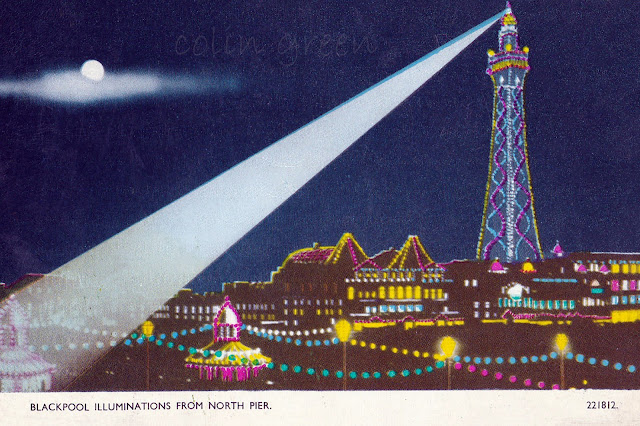
A Glimpse into the Past: Unearthing a Blackpool Illumination Gem from 1933

There's something uniquely satisfying about sifting through a collection, especially when it's something as tangible and evocative as vintage postcards. Each one holds a tiny slice of history, a frozen moment in time, often whispering tales of faraway places and long-forgotten journeys. Recently, while diving deep into my own sizeable postcard archives, I stumbled upon a true treasure that instantly caught my eye.

It's a postcard from the renowned Scottish publisher Valentine & Son of Dundee. For any postcard enthusiast, the Valentine name is synonymous with quality and a vast output of beautifully designed cards, particularly throughout the early to mid-20th century. This particular find, however, felt extra special.


Blackpool's Dazzling Spectacle, Captured in Paint

The card features a vibrant depiction of the Blackpool Illuminations from the North Pier. What makes this one stand out is its captivating artistic style – it's not a photograph, but rather a beautifully rendered painting, transforming the electric spectacle into a work of art. The Blackpool Illuminations themselves are legendary, a beloved annual event that has drawn visitors to the Lancashire coast for over a century. To see them captured in this painterly fashion on a postcard from so long ago is truly a delight.


A Date with History: 1933 and Beyond

One of the most fascinating aspects of collecting postcards is being able to date them, and this card offered a clear clue. Its serial number, 221812, definitively places its printing in 1933. That means this humble piece of cardstock is roughly 87 years old! Imagine the world in 1933: the Great Depression was in full swing, global tensions were simmering, and yet, here was Blackpool, offering a dazzling escape, immortalized on this very card.


Unposted and Enduring

Despite its impressive age, this postcard tells another interesting story: it was never posted. There are no stamps, no handwritten messages, no postmarks to betray a journey through the postal system. It's a blank canvas, preserved almost as it was the day it rolled off the printing press. While it shows some signs of wear and tear, as you'd expect from an item approaching its ninth decade, its overall condition is remarkably good. The colours remain surprisingly vibrant, and the details of the painted scene are still wonderfully clear.

Holding this card, you can't help but wonder about its original owner. Was it bought as a souvenir and simply never sent? Did it sit in a drawer, waiting for a message that never came? Or perhaps it was part of a collection from the very beginning, cherished for its artistic merit and historical significance.


This small, unposted postcard from 1933 is more than just a piece of paper; it's a tangible link to the past, a vibrant reminder of Blackpool's enduring appeal, and a testament to the artistry of Valentine & Son. It's moments like these, unearthing such gems, that make the hours spent sorting through a collection truly worthwhile.


Please take a moment to share this post, follow me on social media, and explore my work on Photo4Me and Clickasnap using the links below. Your support means a lot!


Sunday, 9 August 2020

Happy Birthday Mollie - Vintage Postcard

There's something uniquely charming about old postcards. They're not just pieces of paper; they're tiny time capsules, carrying messages and memories across the decades. In my own collection of celebratory postcards, there's a fascinating set sent to a woman named Mollie from various family members over a number of years. I'm excited to start sharing these little snippets of history with you.


The First Glimpse: A Simple Message from Dad

To kick things off, let's look at the very first card in the collection, a sweet memento Mollie received from her Dad on September 14th, 1936.

What strikes you immediately about this particular card is its beautiful simplicity. The front, which I can only imagine held a cheerful image fitting for a celebration, is unfortunately not something I have to share with you today. But the rear of the card tells its own story. It's clean and unfussy, bearing just two key pieces of information: "Mollie Stuart" written clearly, indicating the recipient, and then, signed simply "From Dad" with the date prominently displayed.

It's a testament to a time when communication, even celebratory, could be succinct yet deeply personal. There's no lengthy message, no flowery prose, just a direct and heartfelt acknowledgment from a father to his daughter.


Please take a moment to share this post, follow me on social media. and explore my work on Photo4Me and Clickasnap using the links below. Your support means a lot!


Chasing Winter Light: A Sunday Stroll in Sowerby Bridge

  Date: December 1, 2019 Location: Sowerby Bridge, West Yorkshire Gear: Nikon D3300 There is something uniquely crisp about the first day...