Showing posts with label Triangle. Show all posts

Saturday, 4 December 2021

Exploring the Rishworth Branch Line: December 2013

As an avid photographer and history enthusiast, few places capture my imagination quite like the remnants of old railway lines. One of my absolute favorite spots to explore with my camera is the Rishworth Branch Line, a fascinating piece of history that once connected the Ryburn Valley with the mainline at Sowerby Bridge.

This railway wasn't just a simple track; it was a vital link, with stations and halts at Rishworth, Ripponden, Triangle, and Watson's Crossing. Even today, much of the line remains remarkably intact. You can still find a number of old bridges providing crossings over the former trackbed, silently witnessing the passage of time.

A Glimpse into its History

The Rishworth Branch Line was initially conceived as the first stage of an ambitious plan: to shorten the railway connection between Sowerby Bridge and Littleborough by about five miles, by tunnelling right underneath the Pennines. Imagine the engineering feat that would have been! However, this grand scheme was eventually abandoned due to difficulties encountered during the construction of the line to Rishworth.

Despite this, the line itself had a significant life. Authorized in 1865 as part of the Lancashire and Yorkshire Railway, the section to Ripponden was completed in 1878, extending to Rishworth in 1881. Stations opened in Rishworth and Triangle that same year. Interestingly, though built for double track, for much of its existence, only one line was actively used, with the second serving as storage for carriages.


The Rise and Fall of a Railway

The turn of the 20th century brought innovation to the line with the introduction of motor railcars. This led to the opening of a new halt at Watson's Crossing in 1907, perhaps marking the peak of the line's usage. However, the golden age was fleeting. Growing competition from trams and the burgeoning popularity of motor cars led to a decline in passenger numbers. Passenger service was eventually withdrawn on July 8th, 1929, with only goods traffic continuing.

The line's final chapters saw further closures. The section between Ripponden and Rishworth closed in March 1952 due to engineering issues, and the entire line officially ceased operations on September 1st, 1958.


What Remains Today

Today, while the station buildings are long gone, along with the former pedestrian bridge, Ripponden Bank road bridge, and the wooden trellis bridge that once connected Rishworth Station with the turnpike, the spirit of the line endures. The Scar Head Tunnel still runs underneath the Norland Hillside (though it's inaccessible), and you can still see the platform at Rishworth, now beautifully reclaimed by vegetation.

Much of the former trackbed is now a fantastic place for walkers to explore, offering a unique journey through history and nature, though it's worth noting that some stretches are privately owned.

These photos, capturing the atmospheric remnants of the Rishworth Branch Line, were taken on December 7th, 2013, with a Samsung Galaxy Tablet. It just goes to show you don't always need fancy equipment to capture the magic of a place!

Clicking any of the images below should open a link in another window to my Colin Green Photography store on Zazzle.

Scar Head Tunnel Portal


The former site of Triangle Station

The pictures above were taken on the stretch of former track bed between Scar Head Tunnel and the site of Triangle Station, the following images were taken between Triangle and Ripponden Stations, although nothing remains of either stop.


The former Ripponden station used to sit at the top of the abutment.

The final set of pictures were taken between Ripponden and Rishworth station sites, This section was the last to open in 1881 and also the first to fully close in 1953.

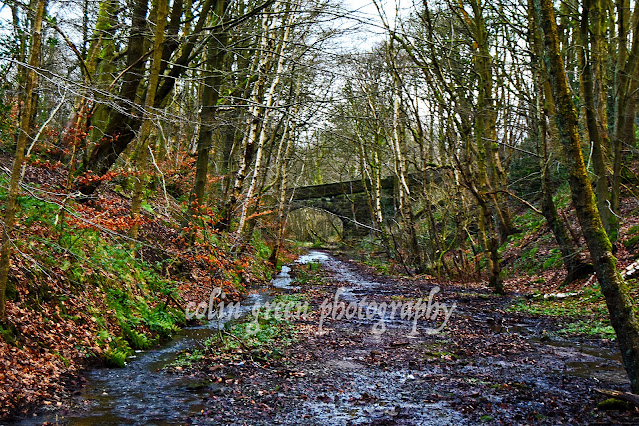
The former trackbed through this section was so wet on the day I was there it resembled a canal rather than the former trackbed of a railway.


The former Rishworth station platform still remained, although largely reclaimed by nature, when I visited it had been 60 years since it had seen a train and 84 since a passenger had waited on it stone concourse.

This was the entrance to Rishworth Station which was reached by a wooden trestle bridge, which constantly had issued regarding stability. The bridge was strengthened in the 1920's and was one of the reasons that led to the closure of Rishworth station in 1953 some 5 years before the rest of the line, when the bridge was demolished.

Please take a moment to share this post, follow me on social media, and explore my work on Clickasnap and Photo4Me using the links below. Your support means a lot!


All the pictures remain the copyright of Colin Green.

Saturday, 23 March 2019

Tracing the Lost Rails: A Journey Along the Rishworth Branch Line

Imagine a time when the rhythmic clatter of trains echoed through the valleys of Calderdale, connecting communities and commerce. That vision was partially realized with the Rishworth Branch Line, a double-track railway that snaked its way from Sowerby Bridge through the charming villages of Triangle and Ripponden, eventually terminating at Rishworth, near Slitheroe Bridge.

The ambition for this line was even grander. The original plan envisioned a seamless connection to the main line at Smithy Bridge, Greater Manchester, by courageously tunnelling under the vast expanse of the moor. Sadly, despite extensive surveys, this grand design was ultimately abandoned. Cost overruns and persistent landslip issues on the already constructed sections proved insurmountable hurdles – a perpetual challenge for railway engineers in this rugged terrain.

The Rishworth Branch Line itself opened in two stages. The initial section, connecting Sowerby Bridge to Ripponden, welcomed its first trains in 1878. Just three years later, in 1881, the final stretch to Rishworth was completed. Over time, further stations were added to serve the growing needs of the communities, with Triangle gaining a station in 1885 and Watson Crossing Halt in 1907.

However, the railway's life was relatively short-lived. By the end of the First World War, the line was already experiencing a decline in usage. Passenger services ceased entirely in 1929, a testament to changing transportation patterns and the rise of road travel. Goods services continued for a while longer, serving Rishworth until 1953 and Triangle and Ripponden until September 1st, 1958.

Between 1958 and 1961, the tracks were progressively removed, and the line was ultimately abandoned, left to be reclaimed by nature. Yet, even today, remnants of this industrial past can be found. Many of the sturdy bridges still stand, as does the enigmatic Scar Head Tunnel (though now inaccessible). Even the station platform at Rishworth, though heavily overgrown, remains as a silent sentinel to a bygone era.

One can't help but wonder about the "what ifs." Had the line been completed to Lancashire, connecting to the broader network, would it still be open today? Perhaps a single, strategically placed station serving the vibrant communities of Triangle, Ripponden, and Rishworth could have ensured its longevity. It must have been a great regret for the railway company that their vision for a fully connected route never materialized.

I've put together a video from my YouTube channel that explores this fascinating lost line. It features a blend of historical images from when the line was in full operation, alongside photographs I took in 2013 and 2017 along the disused trackbed, showcasing how nature has slowly reasserted itself.

Join me on this virtual journey as we trace the ghost of the Rishworth Branch Line and reflect on its legacy in the landscape of Calderdale.


The images from 2013 and 2017 are my own personal pictures, the pictures taken from the days of the lines operation I searched for as public domain and believe them to be so, if I am incorrect I will be happy to add a credit to the video for the pictures owner.

Please take a moment to share this post, follow me on social media, and explore my work on Photo4Me and Clickasnap using the links below. Your support means a lot!


Sunday, 17 February 2019

Scenic Drive Through Ryburn Valley: Scammonden to Sowerby Bridge Pt 3, Pt 4 and Pt 5.

Ever wonder what the winding roads of the Ryburn Valley look like from the driver's seat? I recently took a beautiful walk around the lake beside the M62 and decided to capture the return journey, transforming it into a five-part video series. It was a perfect opportunity to showcase the stunning landscapes and charming villages we passed through.

This video series takes you on a journey from Scammonden all the way to Sowerby Bridge, tracing the Ryburn Valley and passing through picturesque spots like Barkisland, Rishworth, Ripponden, Triangle, and Kebroyd. Each clip is set to music, making for a relaxing and visually engaging experience.

Part 3 features 2.1 miles from the western edge of Rishworth to the centre of Ripponden, West Yorkshire and last's for 4min 27secs.


Part 4 is the 1.5 miles stretch from Ripponden to the western edge of Triangle and is 3min 2 sec long.


The final part 5 covers the 1.9 miles from Triangle to Wakefield Road, Sowerby Bridge and last for 4min 18secs taking in the centres of Triangle and Sowerby Bridge.


Please take a moment to share this post, follow me on social media, and explore my work on Photo4Me and Clickasnap using the links below. Your support means a lot!


Saturday, 18 August 2018

Tracing the Ghost Tracks: A Walk Along the Rishworth Branch Line

The Ryburn Valley, a picturesque slice of West Yorkshire, holds secrets whispered on the winter wind. On a crisp January day in 2016, armed with my Nikon D3300, I set out to explore a fragment of its forgotten past: the Rishworth Branch Line. This railway, a vital artery in its time, once snaked its way up the valley from Sowerby Bridge, connecting Watson's Mill Crossing, Triangle, and Ripponden before reaching its final destination in Rishworth.

Though the last train rattled along these tracks in the 1950s, the remnants of this once-bustling line remain, etched into the landscape. My journey, a roughly half-mile trek, took me from the echoes of Watson's Mill to the quiet village of Triangle. And what a journey it was!

The air was sharp and cold, the ground firm underfoot, as I followed the ghostly path of the former trackbed. The silence was profound, broken only by the occasional rustle of winter-bare trees and the distant murmur of the Ryburn River. It was easy to imagine the steam engines, their rhythmic chugging echoing through the valley, the shouts of passengers and the clatter of cargo.

What struck me most were the bridges. These sturdy stone structures, silent witnesses to a bygone era, still spanned the former trackbed, their arches framing snippets of the valley's beauty. They stood as testaments to the engineering prowess of the past, their weathered stones bearing the marks of time and the elements.

The photographs I captured on that day, the 30th of January 2016, tell a story of quiet resilience. The stark beauty of the winter landscape, the skeletal trees against the pale sky, the weathered stones of the bridges – all combined to create a sense of timelessness.

Walking along the Rishworth Branch Line was like stepping into a historical photograph. It was a journey through time, a glimpse into a world where steam engines ruled the rails and communities were connected by the iron horse.

It's a reminder that even when progress moves forward, the echoes of the past remain, woven into the fabric of the landscape. The Rishworth Branch Line, though silent, continues to tell its story, a story of connection, community, and the enduring beauty of the Ryburn Valley. If you ever find yourself in the area, take a walk along these ghost tracks. You might just hear the whispers of history on the winter wind.

Clicking any of the images below should open a window to my Colin Green Photography store on Zazzle.


Thanks for looking, please take a moment to share and follow me on social media, and check out my portfolio's on Photo4Me and Clickasnap via the links below.


All the images remain the copyright of Colin Green.

Sunday, 20 August 2017

A Journey Through Time: Exploring the Lost Rishworth Branch Line

The Ryburn Valley, a picturesque stretch of West Yorkshire, whispers tales of a bygone era, a time when the rhythmic chug of steam trains echoed through its hills. This is the story of the Rishworth Branch Line, a railway that briefly connected the valley to the wider world, leaving behind a legacy of intriguing remnants for the modern explorer.

Conceived in the ambitious railway boom of the mid-19th century, the Rishworth Branch Line was initially proposed in 1865. However, it wasn't until 1873 that construction finally began. The first section, stretching from Sowerby Bridge to Ripponden, opened its doors to passengers in 1878, a testament to the Victorian engineering prowess of the time. The line was finally completed to Rishworth in 1881, promising to bring prosperity and connectivity to this rural community.

The initial vision for the line was far grander. Ambitious plans included tunnelling through the imposing moorland to connect with the main line at Rochdale. This would have created a significant through route. However, the challenging terrain and persistent problems with landslides and other geological issues meant this ambitious connection never materialized. The Rishworth Branch Line remained a quiet branch, nestled within the Ryburn Valley.

Despite its relatively short lifespan, the line played a vital role in the local economy, transporting goods and passengers and connecting communities. However, the same challenges that plagued its construction ultimately contributed to its demise. Problems with the surrounding land, likely including landslips and subsidence, led to the closure of the section between Ripponden and Rishworth in March 1952. The final nail in the coffin came in September 1958, when the entire line was closed, marking the end of an era for the Ryburn Valley.

Today, the Rishworth Branch Line exists largely in memory, a ghost of its former self. Yet, for those willing to seek them out, remnants of this railway adventure remain. Several of the sturdy bridge crossings still span the valley, silent witnesses to the trains that once thundered across them. The most impressive relic is perhaps the Scar Head Tunnel, a dark and mysterious portal into the past.

And at Rishworth, the station platform still stands, a poignant reminder of the bustling hub it once was. Though now largely hidden by encroaching undergrowth and inaccessible due to being on private land, the platform waits patiently, a silent sentinel dreaming of the trains that will never arrive. It's a powerful image, a testament to the fleeting nature of progress and the enduring charm of forgotten railways.

The Rishworth Branch Line may be gone, but its story continues to fascinate. It's a story of ambition, engineering challenges, and the changing landscape of transportation. It's a story etched into the very fabric of the Ryburn Valley, waiting to be rediscovered by those who dare to look. So, next time you find yourself in the area, take a moment to imagine the sights and sounds of the Rishworth Branch Line, a lost railway that still whispers its secrets to the wind.

The majority of these pictures featured in this slideshow were taken using my Nikon D3300 camera on April 29, 2016.


Thanks for looking and taking a moment to share. Like and follow me if you enjoy my posts using the buttons to the left, or if on Clickasnap or YouTube

Uncovering the Urban Wild: A Stroll Along a Stretch of Halifax's Hebble Trail

There’s a unique charm in finding pockets of forgotten beauty amidst the urban sprawl. On June 13th, 2015, armed with a Polaroid is2132 came...