Monday, 19 September 2022

A Silent Witness on Stocks Lane: The Forgotten Horse Trough of Luddenden

In the charming, ancient village of Luddenden, a small stone structure on Stocks Lane tells a story of a world long gone. At first glance, it might look like a simple, overgrown planter built into a stone wall. But this is no ordinary garden feature; it is a stone horse trough, a silent, weathered monument to the days when horsepower meant exactly that.

Before the age of the automobile, these troughs were a vital part of the landscape. They were strategically placed in towns and villages across the country to provide water for horses, dogs, and sometimes even cattle. Today, most have vanished, removed as they became obsolete. The fact that a dozen or so still survive in the Calderdale district is a testament to their enduring construction and a poignant reminder of a time when the rhythm of life was measured by hoofbeats, not horsepower.

When the photos were taken in October 2013, the trough on Stocks Lane was a perfect example of this forgotten history. It was largely overgrown, with soil, bushes, and plants reclaiming the space where water once flowed freely. The trough was no longer fed by a steady stream, its purpose having faded into memory. But look closer, and a fascinating detail emerges. Tucked away at the back of the trough is a worn stone engraving. It is a tribute to William Patchett, a local carpenter and undertaker. The inscription also includes the year 1861 and the word "surveyor," leaving us with a small historical mystery. Was the inscription a memorial to a man who had passed away that year? Or was it a thank you to him for providing such a crucial resource to the community? We may never know the full story, but the inscription adds a deeply personal layer to this forgotten structure. The stone horse trough on Stocks Lane is a beautiful and simple piece of local history. It's a reminder that even the most ordinary objects from the past can hold compelling stories, if only we take the time to look for them. It stands as a quiet tribute to the animals that once worked these streets and the people who built our communities, one stone at a time.


Please take a moment to share this post, follow me on social media, and explore my work on Clickasnap and Photo4Me using the links below. Your support means a lot!


All the pictures remain the copyright of Colin Green.

Sunday, 18 September 2022

A Stone Sanctuary in the Moors: Our Lady of the Sacred Heart, Lealholm

Nestled in the picturesque North York Moors, the village of Lealholm holds a quiet treasure: Our Lady of the Sacred Heart Church. While many ancient churches dot the English landscape, this small Catholic church has a more modern, yet no less significant, story. It stands not as a remnant of medieval times, but as a testament to the faith and determination of a dedicated local community in the early 20th century.

The church's story began with a simple need for a permanent place of worship. Until the 1930s, the local Catholic community had no church of their own, but their faith was strong. Through persistent fundraising efforts, they gathered the necessary funds to build a modest, yet beautiful, church. Their hard work came to fruition when Bishop Shine laid the foundation stone in September 1931. Just a year later, in 1932, the doors of Our Lady of the Sacred Heart were opened to the public.

What makes this church so compelling is its architecture. Built of local stone, it blends seamlessly with the rugged, rolling landscape of the moors. The design is simple and elegant, featuring a gabled roof and arched windows that evoke a sense of timelessness. The stepped buttresses on the front facade and the cross on the roof are subtle but powerful architectural details.

The building is not just a place for worship; it is a spiritual anchor for the rural community of Lealholm. The graveyard surrounding the church, visible in the pictures, is a quiet space of reflection. The small stone walls and gated entrance complete the picture of a peaceful sanctuary, a place of peace and continuity in a changing world. Our Lady of the Sacred Heart, Lealholm, is a powerful example of how faith and community can build a lasting legacy. It is a modern church with a timeless feel, serving as a reminder that even in an era of rapid change, some things—like faith and community spirit—remain constant.

These 3 pictures were taken on the 27th August 2022 using a Nikon d3300 SLR camera.


Please take a moment to share this post, follow me on social media, and explore my work on Clickasnap and Photo4Me using the links below. Your support means a lot!


All the pictures remain the copyright of Colin Green.

Saturday, 17 September 2022

The Forgotten Giants: Halifax's Berry Lane Coal Drops

Tucked away on a steep embankment in Halifax, a series of crumbling stone arches stands as a silent sentinel to a bygone industrial era. These are the Berry Lane Coal Drops, a striking piece of Victorian engineering that, for decades, has been largely forgotten and left to the forces of nature. Their story is one of a once-vital industrial machine, a fall into disuse, and a modern struggle for survival.

A Legacy of the Rails

Built in 1874 by the Ovenden and Halifax Junction Railway, the drops were a critical piece of the town's industrial infrastructure. Imagine the scene: steam trains from the Halifax Station goods yard would chug along the elevated track, stopping directly above these arches. They would unload coal into a system of 15 drops, each a funnel-like chute designed to transfer coal directly into waiting horse-drawn carts below. The entire system was an ingenious solution to the challenges of moving bulk goods in a hilly landscape, using gravity to streamline the process.

The drops were a bustling hub of activity for nearly a century, but as with so much of Britain's industrial past, their time came to an end. They were largely abandoned in the 1970s as coal's role in industry and heating diminished. The tracks fell silent, the chutes became redundant, and nature began to reclaim the magnificent stone structures.

A Fight for Survival

The Berry Lane Coal Drops are now a poignant symbol of a broader conservation struggle. In 2021, they were added to the Victorian Society's Top 10 at Risk Buildings list, a stark reminder of their precarious state. Despite their overgrown and abandoned appearance, the drops are remarkably intact. Experts believe they are just a few minor repairs away from being fully operational, a bittersweet thought given that their original purpose is now obsolete.

In a curious twist of fate, their Grade II listed status, granted on September 28, 1993, has offered them some protection, preventing their demolition but not necessarily their decay. A plan in 2004 to convert them into houses was proposed, but like many hopeful visions for these old structures, it never came to fruition. A falling piece of masonry in the early 2000s led the council to fence off the bottom, further isolating these grand arches from public view.

Today, the Berry Lane Coal Drops exist in a state of limbo. They are monuments to Halifax's industrious past, overgrown with trees and plants that have taken root in their stone crevices. Their story is a powerful one, highlighting the challenge of preserving our industrial heritage in a world that has moved on. They stand as a silent, beautiful testament to the power of Victorian engineering and a desperate call for a new purpose before time, and neglect, take their final toll.

I took these pictures on the 22nd June 2014 with a Polaroid is2132 camera.


The spire of Square Church can be seen beyond the drops.

I've always liked how the spire of Square Church, and Halifax Parish Church tower bookend this picture of the drops.


These 2 were taken on top od the drops, I accessed it thru some overgrowth in the Eureka car park.

Please take a moment to share this post, follow me on social media, and explore my work on Clickasnap and Photo4Me using the links below. Your support means a lot!


All the pictures remain the copyright of Colin Green.

Saturday, 10 September 2022

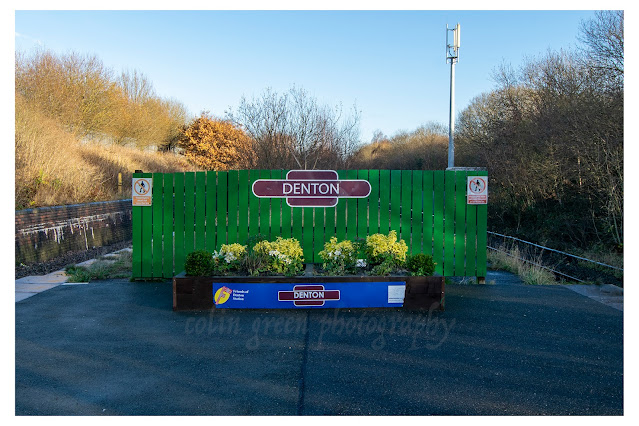
The Ghost Station: A Journey to Denton Railway Station

In the vast and intricate network of the UK's rail system, some stations are bustling hubs, and others are quiet, forgotten corners. Denton Railway Station falls squarely into the latter category, holding a unique and almost legendary status as one of the least-used stations in the country. A visit here isn't just a trip; it's a step into a peculiar slice of modern railway history, a story of managed decline, strategic survival, and a single weekly train service.

A Ghostly Presence

For many, the first thing they learn about Denton Railway Station is its astonishingly low passenger count. With an average of just one passenger a month in some recent years, it is a frequent and prominent feature on the list of least-used stations in the United Kingdom. This isn't due to a lack of local interest, but rather a deliberate policy that has stripped the station of almost all its services and facilities. You'll find no ticket office, no waiting room, no shelters, and no disabled access. The platforms themselves are overgrown and quiet, a stark contrast to the once-busy mainline that used to run through here.

The Train That Keeps the Station Alive

The reason for this minimal service is a fascinating quirk of railway legislation. It is far more complex and expensive to formally close a railway line than it is to simply keep it operational with a bare minimum service. By running just two trains a week—one in each direction on a Saturday morning—the rail company can avoid the costly and lengthy process of a full closure program. This single, weekly service has earned the line the nickname of a "parliamentary train," a service that exists purely to fulfil a legal obligation. As the text mentions, the future of the station is uncertain, as congestion on the line makes it difficult to add more services, but its continued existence is a testament to this unique policy.

Echoes of a Busiest Past

Looking at Denton today, with its lone island platform, it's hard to imagine that this was once a vibrant and busy junction. The station once boasted four platforms, and the line itself was a major artery carrying trains to London Euston. The stark, overgrown platform and the "Way Out" sign that seems to lead to nowhere are poignant reminders of the drastic cuts of the 1960s that reshaped the entire rail network. The station's decline is a microcosm of the wider changes that saw many lines and stations fall victim to rationalization and modernization.

Denton Railway Station is a unique and captivating place, a site that tells a larger story about the evolution of Britain's railways. It stands as a monument to a once-great network and a quirky footnote in the ongoing saga of our public transport system. For rail enthusiasts and curious travellers alike, it's a place to visit not for its convenience, but for its compelling and unusual history.

The pictures were taken with a Nikon d3300 on the 15th December 2020.


Please take a moment to share this post, follow me on social media, and explore my work on Clickasnap and photo4Me using the links below. Your support means a lot!


All the pictures remain the copyright of Colin Green.

Friday, 9 September 2022

The Stone Sentinel of Venice: A Tale of the Rialto Bridge

Venice is a city of magic and myth, and at its heart lies a symbol of its enduring spirit: the Rialto Bridge. More than just a crossing, this majestic stone arch is a bustling marketplace, a historical landmark, and a testament to centuries of resilience. It is the oldest of the four bridges to span the legendary Grand Canal, and its story is one of innovation, collapse, and ultimate triumph.

A Bridge of Many Lives

The bridge you see today is actually the culmination of a long and dramatic history. The very first crossing at this narrow point of the Grand Canal was a modest pontoon bridge, the Ponte della Moneta, built in 1181. It was a simple, practical solution to connect the growing districts of San Marco and San Polo.

As Venice’s commerce boomed, particularly with the thriving Rialto market nearby, a more substantial crossing was needed. In 1255, the pontoon bridge was replaced by a wooden structure that, remarkably, featured a movable platform in the middle to allow tall ships to pass. It was this bridge that first housed shops whose rents helped fund the bridge's maintenance. The name was also changed to "Rialto," a nod to the nearby market and the heart of Venetian trade.

However, the wooden bridges were fragile. They were repeatedly damaged by fire—notably during a failed coup attempt by Bajamonte Tiepolo in 1310—and twice collapsed entirely. The most spectacular collapse was in 1444, when it buckled under the weight of a huge crowd celebrating the wedding procession of the Marquis of Ferrara.

The Birth of a Masterpiece

After yet another collapse in 1524, Venetian authorities decided a stone bridge was the only way forward. In 1551, they launched a competition, attracting proposals from the greatest architects of the day, including Michelangelo and Palladio. Yet, it was the bold design by Antonio da Ponte that won. His plan for a single-span arch was revolutionary and, to many, terrifyingly ambitious. Skeptics predicted it would collapse, but the design’s practicality and elegance convinced the city.

Work began in 1588 and, thanks to a staggering feat of engineering, was completed just three years later. To support the immense weight of the stone arch and its shops, over 6,000 timber piles were driven into the soft Venetian mud on each side. The result was a bridge of immense strength and beauty, a landmark that defied its critics and has stood firm for over 400 years.

A Living, Breathing Landmark

The Rialto Bridge is a marvel of both architecture and function. Spanning 31.8 meters with a height of 7.32 meters and a width of 22.9 meters, it's an imposing presence. But what truly makes it unique is its inner life. Two arcades of shops run along its length, selling everything from traditional Venetian crafts to high-end jewelry. A central pathway of steps, flanked by these bustling shops, leads to two panoramic viewpoints at the very top. These offer stunning, unobstructed views of the Grand Canal, with its constant procession of gondolas, vaporetto water buses, and historic palaces. Walking across the Rialto Bridge today is to be part of a continuous, living history. You can feel the echoes of merchants trading, lovers meeting, and artists drawing inspiration from its majestic form. It's not just a way to get from San Marco to San Polo; it’s an essential part of the Venetian experience, connecting its past, present, and future.

I took the pictures below on the 30th October 2018 with a Nikon d3300.


Please take a moment to share this post, follow me on social media, and explore my work on Clickasnp and Photo4Me using the links below. Your support means a lot!


All the pictures remain the copyright of Colin Green.