Saturday, 25 July 2020

A Postcard from Burnham-on-Sea's Manor Gardens

Today, let's step back in time with a fascinating find from my personal collection: a beautiful, unposted postcard depicting the charming Manor Gardens in Burnham-on-Sea. What makes this particular card so intriguing isn't just the picturesque scene, but the mystery surrounding its origins and the delightful message it carries.

At the heart of the image stands the bandstand, a classic feature of many early 20th-century public gardens, undoubtedly a focal point for leisure and entertainment back in its day. Even now, the Manor Gardens remain a beloved green space in Burnham-on-Sea, a testament to their enduring appeal.

While the postcard itself bears no postmark, making an exact date elusive, I'd hazard a guess that it hails from the post-First World War period. This era saw a resurgence in seaside holidays and leisure activities, making Burnham-on-Sea a popular destination for those seeking relaxation and enjoyment.


A Message from the Past

Despite never being mailed, this postcard carries a handwritten message, offering a precious, albeit partial, glimpse into the lives of its senders. The faded script, though challenging to decipher completely, reads as follows:

"Dear Phyliss we are having a lovely time plenty of attractions and crowds of people we are getting along nicely we have lovely lodgings and quite near the sea front you'll wish you were here we are first going to the Manor Gardens love _____ and _____."

Sadly, the names of the senders are illegible, lost to the passage of time. Yet, even without their identities, their words paint a vivid picture: a joyful holiday filled with "plenty of attractions and crowds of people," comfortable "lovely lodgings" close to the sea, and a clear sense of contentment and happiness. One can almost feel their excitement as they anticipate their visit to the Manor Gardens, perhaps to enjoy a bandstand concert or a leisurely stroll amidst the flowers.


This postcard, unposted and anonymous as it may be, serves as a poignant reminder of simpler times and the enduring pleasure of a seaside escape. It’s a tiny fragment of history, allowing us to imagine the lives and experiences of those who visited Burnham-on-Sea over a century ago.

Please take a moment to share this post, follow me on social media.

Friday, 24 July 2020

A Glimpse into the Past: Weston-Super-Mare, 1917

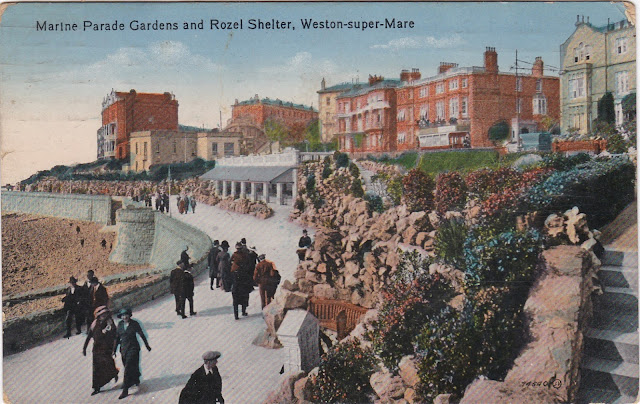
magine holding a piece of history in your hands, a tangible link to a time long past. That's precisely the feeling evoked by a recent discovery: a vintage postcard mailed over a century ago, on September 12th, 1917. Despite the ravages of time, this postcard offers a fascinating, albeit faded, window into the Edwardian era, specifically featuring the charming Marine Parade Gardens and Rozel Shelter in Weston-Super-Mare.


Echoes of a Bygone Era: The Faded Message

The most poignant aspect of this postcard is its badly faded written message. While the postal print remains remarkably clear, the personal words intended for a loved one have largely succumbed to time, leaving us to wonder about the full sentiment they once conveyed. However, with careful deciphering, a fragment of the past emerges:

Mr F Denning,
30 Hanham Road, Kingswood, Bristol.

Dear Dady, just a few lines hoping you arrived home alright and what time did you get home last night


A Snapshot of Daily Life Amidst Global Conflict

It's humbling to consider that this simple message, inquiring about a father's safe return, was penned in the midst of World War I. While battles raged across Europe, life continued on the home front. This postcard serves as a powerful reminder of the enduring human need for connection and reassurance, even in the most tumultuous times. It speaks to the everyday concerns and affections that persisted amidst the broader global conflict.


Then and Now: Weston-Super-Mare's Enduring Beauty

The image itself transports us to Marine Parade Gardens and Rozel Shelter. A natural question arises: does the Rozel Shelter still stand today? While its fate remains a mystery without further investigation, we do know that the Marine Gardens themselves have stood the test of time, continuing to grace Weston-Super-Mare with their beauty. This contrast between the potentially lost and the enduring offers a compelling insight into the evolution of our landscapes.

The back of the card offers another tangible link to the past: a King George V Half Penny stamp remains firmly attached, a small but significant detail that helps date the postcard and grounds it in its historical context.


This vintage postcard, with its faded script and enduring imagery, is more than just a piece of paper; it's a whisper from the past, inviting us to contemplate the lives of those who walked these paths before us. It sparks curiosity about the stories behind the names, the everyday moments that made up a lifetime, and the remarkable resilience of both nature and human connection.


What other forgotten messages do you think are waiting to be discovered, telling tales of a world we can only imagine?


Please take a moment to share this post, follow me on social media.

Thursday, 23 July 2020

A Vintage Postcard from Brixham

I recently came across a fascinating vintage postcard in my collection, offering a small window into the past. The postcard depicts the Prince of Orange Monument, a prominent landmark on the seafront at Brixham, Devon.

The Postcard's Message

Postmarked August 1935, and sent from Paignton, the card is addressed to:

Miss Joan Harding, Ivy Lodge, West Malvern, Worcestershire.

The message on the back, though slightly faded, reveals a personal touch:

Here is a picture for your scrap book on holiday memories, for your history project book. I saw the statue on holiday when I went to Brixham. I also watched the fishermen cleaning the nets on the quay. Brixham is such a quaint place. I am delighted to hear you are better. Love from W.U.

The Prince of Orange Monument

The postcard's subject, the Prince of Orange Monument, commemorates a significant event in English history. It marks the landing of William of Orange and his army in Brixham on November 5th, 1688. This event was the start of the Glorious Revolution, which saw William take the throne as King William III of England on April 11th, 1689.

The monument itself is a striking white marble statue standing on a granite pedestal. The statue depicts William, Prince of Orange. The monument was erected in 1888-1889. The south-west face of the pedestal has an inscription:

WILLIAM PRINCE OF ORANGE, AFTERWARDS WILLIAM III. KING OF GREAT BRITAIN & IRELAND LANDED NEAR THIS SPOT 5TH NOVEMBER 1688 AND ISSUED HIS FAMOUS DECLARATION "THE LIBERTIES OF ENGLAND AND THE PROTESTANT RELIGION I WILL MAINTAIN"

The monument has been a Grade II listed building since 1949, recognizing its historical importance.

Brixham: A Quaint Fishing Town

The sender of the postcard, W.U., describes Brixham as a "quaint place," and this description still holds true today. Brixham is a charming fishing town with a rich maritime history. Its picturesque harbor, filled with colorful fishing boats, is a testament to its enduring connection to the sea. The image of fishermen cleaning their nets, mentioned in the postcard, is a timeless scene that continues to be part of Brixham's daily life.

A Connection to the Past

This vintage postcard offers more than just a scenic view. It provides a personal connection to a specific moment in time, linking the sender, the recipient, and the historical significance of Brixham. It's a reminder of how postcards served as a means of sharing experiences and memories, creating a tangible link between people and places.


Please take a moment to share this post, follow me on social media.

Monday, 20 July 2020

St Peter's Church, Walsden

Nestled amidst the picturesque landscape, visible from the tranquil waters of the Rochdale Canal, stands the elegant spire of St. Peter's Church in Walsden. A silent sentinel, it marks a spot steeped in history, resilience, and community spirit. I first encountered this striking landmark on a canal-side stroll back on August 27th, 2017, its distinctive outline drawing me in for a closer look at the locked-up grounds. What I uncovered about its past is a testament to both grand Victorian ambition and the enduring power of local devotion.

The "Million Pound Church" Legacy: A National Endeavour

St. Peter's Church, which first opened its doors on August 7th, 1848, was no ordinary parish church. It was part of a remarkable national initiative – the "Million Pound Churches." This ambitious project was born from the 1820 Church Building Act, a parliamentary response to the rapid industrialisation and urban growth that had left many burgeoning towns, like Walsden, with inadequate places of worship.

Imagine the foresight: an act of parliament, financed by a blend of government and public funds, dedicated to addressing the spiritual needs of a changing nation. These churches, though often built to very tight budgets, were designed to be beacons of faith in newly developing communities. St. Peter's stands as a tangible link to this fascinating chapter in British social and architectural history.

A Foundation of Generosity and a Spire of Distinction

The very genesis of St. Peter's Church speaks of local philanthropy. The foundation stone was proudly laid in July 1846 by John Crossley, a man whose generosity extended to donating the very land upon which the church would rise. It's a reminder that even grand national schemes often relied on the vital contributions of individuals.

Sixteen years after its initial opening, in 1864, a significant architectural addition graced the church: its magnificent spire. This elegant structure, now a Grade II listed building, is not just a beautiful piece of design; it holds a profound significance. As fate would have it, it is virtually all that remains of the original edifice after a devastating event.

The Fiery Trial of 1948: A Community Rises

The year 1948, exactly a century after its grand opening, brought an unimaginable tragedy to St. Peter's. In May of that year, a fierce fire ravaged much of the building, destroying countless irreplaceable elements, including its beautiful windows. In a poignant detail, the church clock remarkably continued to function throughout the blaze, even striking midnight as the inferno raged. It's a vivid image, a symbol of time marching on even in the face of immense destruction.

Adding to the heartache, the church lacked adequate insurance – a common vulnerability for many public buildings of that era. This meant that the task of rebuilding fell squarely on the shoulders of the local community and the dedicated parishioners. And rise they did! Through incredible collective effort, fundraising drives, and an unwavering commitment, the people of Walsden pieced their beloved church back together. It's a powerful narrative of resilience, a testament to how adversity can forge an even stronger sense of community. On March 10th, 1956, after years of painstaking work and tireless fundraising, St. Peter's Church was proudly re-consecrated, reborn from its ashes.

A Lingering Legacy

Today, the spire of St. Peter's Church continues to grace the Walsden skyline, a beacon of history, a monument to a national initiative, and a powerful symbol of local determination. My own encounter with it from the Rochdale Canal was just a brief snapshot, but the story behind its walls, and indeed its very survival, is one that speaks volumes about faith, community, and the enduring spirit of a place. It reminds us that even seemingly quiet architectural landmarks often hold a rich tapestry of human stories, waiting to be discovered.


Please take a moment to share this post, follow me on social media.

All the pictures remain the copyright of Colin Green.

Sunday, 12 July 2020

Todmorden's Unique Guillotine Lock

Nestled near the heart of Todmorden, adjacent to the Golden Lion Bridge (Bridge 30), lies Lock 19 on the Rochdale Canal. This distinctive lock, often referred to as Todmorden Lock or even Library Lock, holds a fascinating secret: it's a guillotine lock.

What makes it a guillotine lock? Unlike traditional canal locks with swinging gates, the eastern gates of Lock 19 were replaced with a guillotine mechanism. This unusual modification was necessary due to their close proximity to the bridge, making conventional gates impractical.

Here are some glimpses of this unique piece of engineering:

The first three pictures, captured on July 11, 2020, showcase the lock in recent times. You can see the intricate workings of the guillotine gate and its seamless integration with the surrounding canal architecture.

For a different perspective, an additional image from November 9, 2013, offers a view eastwards, clearly illustrating the guillotine lock and the adjacent bridge. It's a testament to the enduring presence of this historical waterway feature.

Lock 19 is more than just a functional part of the Rochdale Canal; it's a small but significant piece of engineering history, reflecting the adaptive solutions employed to navigate the challenges of canal construction. Next time you're in Todmorden, take a moment to appreciate this unique lock!

Lock 19, Rochdale Canal, Todmorden

Artwork at Todmorden Lock 19, Rochdale Canal

Rochdale Canal Lock 19, Todmorden

The following picture is the November 2013 image of the lock, it was taken using a Samsung Galaxy tablet,

Todmorden Guillotine Lock

Please take a moment to share this post, follow me on social media.

All the pictures remain the copyright of Colin Green.