Wednesday, 28 December 2016

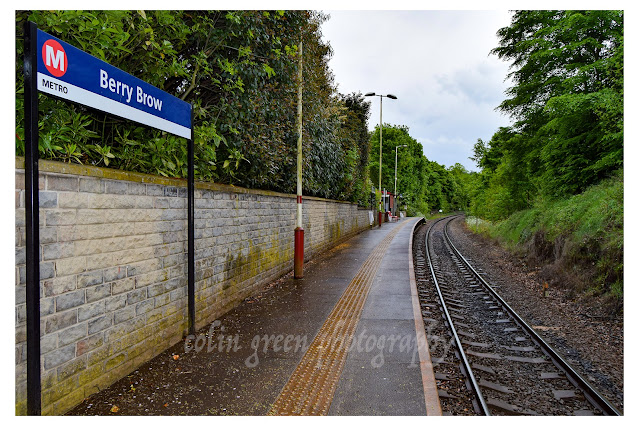
Berry Brow Railway Station.

Nestled amidst the rolling hills of the Holme Valley, Berry Brow railway, originally opened on the 1st July 1850, as part of the Lancashire and Yorkshire Railway, the station served the local community until its closure on the 2nd July 1966, before reopening on the 9th October 1989 300 yards from the site of the original station. Both Halts witnessed countless journeys and stories unfold within its walls.

Today, Berry Brow station operates as a delightful single platform halt on the scenic Penistone Line. Passengers can hop on and off, enjoying the convenience of a quick commute or embarking on a leisurely exploration of the surrounding countryside. The station itself boasts a quaint charm with its single platform hidden away inside a railway cutting.

Beyond the station lies a treasure trove of sights and experiences. The village of Berry Brow itself is a quaint haven, offering traditional pubs, cosy cafes, and independent shops nestled amidst charming stone cottages. For the more adventurous, the surrounding hills beckon with their hiking trails, panoramic views, and hidden waterfalls.

Berry Brow station is more than just a transport hub; it's a vital part of the community fabric. Local residents gather here for daily commutes, weekend outings, or simply to meet friends and family visiting.

Whether you're a train enthusiast, a history buff, or simply seeking a charming escape, Berry Brow Station is a worthwhile destination. Trains run regularly from Huddersfield and Sheffield, making ii easily accessible. So, pack your bags, hop on board, and discover the magic of Berry Brow Station for yourself!

I took a total of 5 pictures at the station with a Nikon d3300 on the 21st May 2016.

An image of a wet, single-platform railway station, looking down the tracks. On the left is a stone wall with green bushes on top. The tracks curve to the right into the woods. In the foreground on the left, there is a sign that reads: "Berry Brow" and "METRO" with a large "M". A long line of bumpy yellow tactile paving marks the edge of the platform next to the tracks. The sky is grey and overcast.

High angle view looking down along single-track railway line and platform of Berry Brow railway station, set within a lush, green cutting with trees and shrubs.

A view looking up a paved pedestrian pathway towards Berry Brow Railway Station in the UK. On the left is a red metal handrail, with dense greenery and a row of flowering laurel bushes on the right. In the background, the distinctive 'M' logo sign for the Metro network is visible, next to a railway line and station buildings with chimney pots under a partially cloudy sky.

A photograph of Berry Brow railway station in Northern England, featuring a waiting room with a red roof, several red seats, and the platform sign against a backdrop of trees and a brick retaining wall. A train is approaching the platform, and the image captures the typical station environment with subtle colour accents.

A photograph looking down the length of the single platform at Berry Brow railway station, which curves gently to the left following the tracks. The concrete platform surface is dark and slightly wet, featuring a strip of tactile paving running down its center. Parallel to the platform are the single railway line and wooden sleepers on a bed of gravel ballast. To the right, a low grey stone block wall forms the platform boundary, topped by dense, green bushes that spill over the edge. Behind the bushes, trees and the edge of a residential building are visible. In the background, the railway line curves under a concrete bridge with an iron railing. The scene is set under a light, overcast sky.

Please take a moment to share this post, follow me on social media, and explore my work on Clickasnap and Photo4Me using the links below. Your support means a lot!


All the pictures remain the copyright of Colin Green.

Friday, 4 November 2016

Allan Park, Sowerby Bridge A Photographic Journey Through a Tranquil Setting.

 Allan Park is a hidden gem nestled near the heart of Sowerby Bridge. With its lush greenery, winding paths, and captivating views, it's no wonder this park has become a favourite amongst locals and photographers alike. Today, I'm taking you on a visual journey through Allan Park, sharing some of its hidden corners and capturing its unique blend of tranquility and history.

The moment you enter Allan Park, you're greeted by a canopy of towering trees, their leaves filtering the sunlight into a dappled mosaic. The air is filled with the sweet scent of blooming wildflowers and the gentle chirping of birds. As you wander along the paths, sunlight peeks through the leaves, illuminating patches of vibrant green moss blanketing the ground. It's a scene straight out of a fairytale, offering a welcome escape from the hustle and bustle of daily life.

Allan Park's history is woven into its very fabric. The Rishworth Branch Line Scar Head Tunnel, running directly beneath the park, adds a touch of industrial intrigue. The weathered stone bridge, a testament to the area's rich heritage, stands proudly against the backdrop of lush greenery. Capturing these historical elements alongside the park's natural beauty creates a visual dialogue between past and present, reminding us of the stories these spaces hold.

For photographers, Allan Park is a treasure trove of opportunities. From the delicate details of a spiderweb glistening with morning dew to the majestic silhouette of a tree against the setting sun, there's beauty to be found in every corner. Don't miss capturing the playful antics of squirrels scampering amongst the trees or the vibrant hues of wildflowers blooming in the meadows.

Whether you're seeking a peaceful escape, a spot for creative inspiration, or simply a chance to connect with nature, Allan Park has something to offer everyone. So, grab your camera, lace up your walking shoes, and embark on your own photographic adventure through this charming Sowerby Bridge
 haven.

The picture below were taken in the park grounds with a Nikon d3300 in May 2016.

A view from a high angle looking down onto a bowling green in Allan Park, Sowerby Bridge. In the foreground, there are bushes and trees, while the green itself is well-maintained with short grass. In the background, there are tall trees and multi-story buildings, along with a bright blue sky with white, fluffy clouds.

A close-up photograph of a cluster of white rhododendron flowers with golden-yellow speckled centers, surrounded by large, dark green leaves. The background is a soft, sun-dappled green and white bokeh.

A sepia-toned photograph looking down a sun-dappled woodland path in Allan Park, Sowerby Bridge. A slatted wooden bench sits on a paved area to the left, beneath a steep, wooded slope, while a large, gnarly tree branch frames the right side of the view. The path curves gently as it recedes into the dense woods.

A wide-angle, sunlit view looking across a large, meticulously manicured green lawn, likely a bowling green, at Allan Park in Sowerby Bridge. In the foreground, a gravel path with a prominent linear gutter edge runs along the left side. The green lawn fills most of the frame, with the soft, dappled shadows of nearby trees falling across it. At the far side of the green is a small, white-walled park pavilion with a green roof, nestled against a steep, densely wooded hillside covered in lush spring and early summer trees. To the right of the pavilion, a prominent horse chestnut tree is in white flower, and further right is a large deciduous tree with a more delicate canopy. The sky is partly cloudy with blue patches, creating a bright and clear atmosphere. The composition is clean and peaceful, capturing the quiet character of a traditional municipal park.

A paved path with stone curbing winds into a densely wooded area with various trees and flowering bushes. A large white flowering shrub is in the foreground.

A close-up photograph of a rhododendron plant in Allan Park, Sowerby Bridge. In the center, a single, tightly closed purple flower bud with light green sepal covers is positioned on a stem. The bud is surrounded by the large, dark green, glossy leaves of the rhododendron bush. The background is a dense, out-of-focus mix of green and brown foliage, creating a field of soft, colorful, bokeh light effects. The image has a clean white border.

A view along a wooded dirt trail at Allan Park in Sowerby Bridge, flanked by green leafy bushes and stone retaining walls under bright natural sunlight.

A small, brightly colored children's playground, enclosed by yellow, green, and red metal fencing, is nestled in a clearing at the end of an asphalt path. The playground is surrounded by dense, leafy green trees under a partly cloudy sky. The path leads to the foreground.

A high-angle, downward perspective looking along the aged, moss-covered brick battlement and retaining wall of a Victorian-era structure, Scar Head Tunnel, within Allan Park. The weathered bricks are heavily covered in vibrant green moss. The wall slopes down to the right, showing a brick archway and a lower-level concrete path in the shadow. Above the wall on the left is a steep, dark, leafy, and overgrown embankment with exposed branches and dense foliage.
The tunnel portal is the entrance to Scar Head Tunnel. The tunnel runs for 542m underneath
Allan Park and was closed to railway traffic in 1958. Both sides of the tunnel are
partially blocked by industrial developments. This is the Sowerby Bridge
Station side.

A steep, narrow flight of stone steps ascends a grassy, sunlit hillside in Allan Park, Sowerby Bridge. The steps are rugged and worn, flanked on both sides by wild green grasses, leafy bushes, yellow wildflowers (like dandelions), and larger tree trunks (likely birch) on the left. Bright, dappled sunlight filters through the tree canopy, illuminating the steps as they curve upwards and disappear into the densely forested upper park area.

A narrow, dirt-covered walking path with stone steps leads up a wooded hillside in Allan Park, Sowerby Bridge. The path is flanked on the left by dense, green bushes and trees, and on the right by a steep, dirt bank covered with dried twigs and branches. Fallen leaves are scattered across the trail. Light filters through the canopy ahead.

A dirt trail curves through the lush, shaded Allan Park woodland in Sowerby Bridge, Yorkshire, beside a set of uneven, moss-covered stone steps that ascend a grassy, ivy-draped hillside. Sunlight filters dramatically through the dense canopy of vibrant green beech and sycamore leaves.
Please take a moment to share this post, follow me on social media, and explore my work on Clickasnap and Photo4Me using the links below. Your support means a lot!


All the pictures remain the copyright of Colin Green.

Wednesday, 2 November 2016

Portinatx, Ibiza's Hidden Gem

Ibiza is known for its vibrant nightlife, but the island also has a quieter side, with many hidden coves and beaches perfect for relaxation. Portinatx is one such gem, a small resort on the island's north coast that offers a laid-back atmosphere and stunning scenery. 

What to do in Portinatx 

  • Relax on the beach. Portinatx has two main beaches, S'Arenal and Xarraca, both of which are small and sheltered. The sand is soft, and the water is crystal clear, making them perfect for swimming and sunbathing. 

  • Go for a hike. There are several hiking trails in the area, including one that leads to the top of a cliff with panoramic views of the coast and another that follows the coast to the lighthouse at Far del Moscarter. 

  • Explore the underwater world. There are several dive sites around Portinatx, which is home to a variety of marine life. 

Where to stay in Portinatx 

There are a few hotels and apartments in Portinatx, but most of the accommodation is in the form of villas and holiday homes. This makes Portinatx a great option for families and groups of friends who want their own space. 

How to get to Portinatx

The nearest airport to Portinatx is Ibiza Airport, which is about 30 minutes away by car. There are also regular buses from Ibiza Town to Portinatx and a regular boat service from the beach to a number of interesting locations on the island.
 
These pictures were taken in July 2014 using a Polaroid iS2132 digital camera. The pictures shown are of the town of Portinatx; the pictures I took of the pirate tower and lighthouse will feature in separate posts.

A photographic landscape of a calm bay in Portinatx, Ibiza, at sunset. Gentle, clear blue and peach-colored waves lapping at a dark, textured beach in the foreground. Several white sailboats are moored in the distance, silhouetted against a vibrant sky with large peach and blue-pink painted clouds. Two dark, tree-covered land masses frame the bay, with small lights visible on the right. The entire scene is mirrored in the shimmering water, creating a tranquil atmosphere.

A cobbled path with a low stone wall curves down towards a sandy beach cove in Portinatx, Ibiza. People walk along the path and relax on the crowded beach, which has clear turquoise water, colourful parasols, and white buildings on the hillside.

An elevated view of the sandy Cala Portinatx beach on Ibiza, dotted with rows of umbrellas and sunbeds. Swimmers and people relaxing enjoy the turquoise water, framed by green pine trees and the white buildings of the surrounding resort. A sailboat is anchored in the bay under a blue sky.

A wide-angle landscape photograph looking across a rocky bay to the village of Portinatx, Ibiza, under a bright, partly cloudy sky. In the foreground, there are large, textured rock formations. Across the deep blue water of the bay, multiple white-hulled yachts are anchored. In the middle distance, the white buildings of Portinatx village cluster at the base of a large, green, pine-covered mountain range that fills the background.

A panoramic view overlooking the beach of Portinatx in Ibiza, captured from a rocky hillside. The turquoise water of the bay is filled with people swimming and wading, with colorful umbrellas dotted across the sandy beach. Adjacent to the beach is a white, multi-story hotel and a restaurant with arched windows. Lush green pine trees line the background hills under a bright blue sky.

A panoramic view overlooking the turquoise-blue water of Cala Portinatx cove in Ibiza, surrounded by lush green pine-covered hills and rocky cliffs. Several yachts and sailboats are anchored in the calm, sunlit bay under a clear blue sky.

A view looking across a rocky, low-scrub headland towards a deep blue cove filled with small boats, with white villas on the hillside and a lighthouse in the distance under a blue sky, identified as Portinatx, Ibiza.

A scenic high-angle view of a serene cove in Portinatx, Ibiza, with numerous small white and blue motorboats and rowboats anchored in the clear, turquoise and emerald green water, framed by green Mediterranean pine trees and rocky, scrub-covered headlands under a clear blue sky. A dirt path is visible on the foreground slope, and a traditional white stucco building is partially seen on the right.

A scenic, wide-angle landscape photograph of Portinatx bay in Ibiza. The view is taken from a rocky, red-ochre and tan headland in the foreground, with dark, irregular rocks meeting the clear blue water. Across the calm bay, several sailboats and small motorboats are anchored. On the far-right headland, a small town with whitewashed buildings and restaurants is visible nestled among pine trees. The distant background shows more of the hilly coastline under a wide blue sky with streaky cirrus clouds. A small group of people are sunbathing and swimming on the far-right shore near the buildings, and a few individuals are swimming closer in the bay. In the foreground on the left, a solitary bird (a cormorant or similar) sits on the rocks. The lighting is sunny and warm, suggesting late afternoon.

A wide-angle landscape photograph captured at Portinatx, Ibiza, showing a peaceful bay at sunset. The sky is filled with hues of pink, orange, and light blue, with soft clouds reflecting over the calm sea. Multiple sailboats are anchored and silhouetted in the water, their tall masts casting long shadows on the surface. Dark, rocky landforms frame the scene in the background and foreground, enhancing the coastal landscape.

A wide landscape photograph captures a calm Portinatx Bay in Ibiza, Spain. In the foreground, a rugged, rocky cliff with sparse green vegetation meets a stone-paved walkway. The turquoise blue Mediterranean Sea is filled with several sailing boats anchored in the water and small buoys. The distant coastline is covered in lush green pine trees with buildings, including a white hotel complex, nestled into the hillside under a clear blue sky.

A wide-angle landscape photograph of the beach at Portinatx, Ibiza, on a clear summer day. The view shows a concrete promenade on the left, leading to a golden sand beach in a natural cove surrounded by rocky cliffs and green trees. People are relaxing on sun loungers under beige umbrellas, with several small boats anchored in the calm turquoise water of the bay.

A panoramic view overlooking the picturesque cove of Portinatx, Ibiza. The turquoise bay is dotted with anchored sailboats and yachts. On the sandy beach below, people are sunbathing under colorful umbrellas and swimming in the clear, shallow water. The surrounding cliffs are covered in lush green pine trees, with white-washed buildings nestled on the far hillside. A stone staircase is in the foreground, leading down to the shore.

A sunny, scenic view of three yachts anchored in the crystal-clear waters of a coastal bay in Portinatx, Ibiza, surrounded by rocky headlands and pine trees.

A long-distance daytime photograph captures the view looking across a natural cove, where several small boats are moored, towards a distant coastline. In the foreground, dense green and brown brush and small trees dominate the right side and bottom. Beyond the cove, on a higher cliff on the opposite shore, the distinctive striped white and black Punta de sa Galera lighthouse stands tall against a pale sky. The distant cliffs are arid and brushy. The image has a slightly painterly, stylized quality.

An elevated viewpoint overlooking the tranquil Cala Portinatx bay on the northern coast of Ibiza, Spain, on a sunny day. Multiple sailboats and motorboats are anchored in the clear turquoise and deep blue waters of the inlet, which features vibrant patches of sandy and rocky seabeds. The bay is enclosed by green, pine-forested headlands and hillsides, framed by lush Mediterranean shrubs and pine branches in the immediate foreground. The small whitewashed buildings of Portinatx village can be seen across the water on the distant shoreline under a pale blue, hazy sky. The scene is peaceful and scenic.

Please take a moment to share this post, follow me on social media, and explore my work on Clickasnap and Photo4Me using the links below. Your support means a lot!


All the pictures remain the copyright of Colin Green.

Saturday, 8 October 2016

The Church of St John the Baptist, Rogerstone, South Wales.

The Church of St John the Baptist is a beautiful and historic church located in the village of Rogerstone, Wales. It was opened in 1888 and designed by the architect E.A. Johnson. The church is dedicated to St John the Baptist, and its foundation stone was laid by Lord Tredegar in August 1887.

The church is built in the Gothic Revival style, and it is made of red sandstone. The church has a nave, chancel, aisles, and a tower. The interior of the church is decorated with stained glass windows, wood carvings, and stonework.

The Church of St John the Baptist is a popular place for weddings and baptisms. It is also a busy community centre, and it hosts a variety of events throughout the year.

The need for a new church in Rogerstone arose in the mid-19th century as the population of the village grew rapidly. The existing church, St Peter's Church, was too small to accommodate the growing congregation.

In 1885, a committee was formed to raise funds for the building of a new church. The committee was successful in raising £2,370, and the foundation stone for the new church was laid in August 1887.

The new church was opened in 1888, and it was consecrated by the Bishop of Llandaff. The church was originally a Church of England church, but it became a Church of Wales church in 1920.

The Church of St John the Baptist is a thriving church community. It has a congregation of over 200 people, and it offers a variety of services and activities for all ages.

The church is also a busy community centre. It hosts a variety of events throughout the year, including coffee mornings, concerts, and fundraising events.

The Church of St John the Baptist is a beautiful and historic church that is an important part of the community of Rogerstone. It is a place of worship, a community centre, and a symbol of hope for the future.

In addition to the information above, here are some other interesting facts about the Church of St John the Baptist:

  • The church has a peal of six bells, which were cast in 1888.
  • The church has a churchyard, which is home to the graves of many local people.
  • The church is a Grade II listed building.
A side-profile view of a weathered stone church with two large arched windows, surrounded by a grassy graveyard filled with various headstones and stone crosses. Large evergreen trees frame the scene under a bright blue sky, with long shadows stretching across the lawn in the foreground.

A sepia-toned photograph of a stone church building, focusing on an arched entrance portal with metal gates, partially framed by large tree branches. The view is set within a graveyard with old headstones and stone grave borders in the foreground and various trees, all rendered in monochromatic, antique brown tones.

A view of a historic stone church building on the left, set against a backdrop of mature, dense green trees. The foreground features a grassy area and an old graveyard with many diverse gravestones. In the midground, a path leads to a large, prominent tree on the right side of the frame.

A side-view photograph of a historic, grey stone church with a dark slate roof, situated in a green grassy churchyard with old gravestones. Large evergreen trees frame the left side, and a bell cote sits on the left gable. The church features arched windows and buttresses.

A view through mature pine and evergreen trees of an old, dark stone gothic chapel and its graveyard. The photo is taken in dappled sunlight, highlighting several gravestones, including two prominent rounded ones in the foreground and a stone cross further back. The chapel entrance with its arched doorway and cross finial is partially visible.

A black-and-white photograph of a graveyard. A gravel path recedes from the foreground, flanked by grassy areas and numerous headstones of various styles and ages. Large, mature trees with dense foliage, possibly pine and yew, cast long, dapple shadows across the path and the rows of graves. In the distance, a few modern houses or buildings are partially visible behind the cemetery boundary. The light is bright, creating a stark, textured monochrome effect.

A low stone wall in the foreground leads the eye to a quaint, old stone church building with a large slate roof and arched windows under a blue, partly cloudy sky. The churchyard is filled with numerous weathered gravestones of various styles, and the scene is surrounded by large, mature cypress and pine trees.
Please take a moment to share this post, follow me on social media, and explore my work on Clickasnap and Photo4Me using the links below. Your support means a lot!


All the pictures remain the copyright of Colin Green.

Sunday, 2 October 2016

Technicolour Sunset in Brechin, Scotland.

There are moments when the world seems to shed its ordinary skin, trading the muted tones of the everyday for a palette that feels almost supernatural. We’ve all had those evenings—the ones where you’re mid-sentence, perhaps washing dishes or walking to your car, and a sudden shift in light pulls your gaze upward. For a few fleeting minutes, the atmosphere performs a symphony of color so loud it demands absolute silence from everyone below.

The images before us aren't just snapshots of a day ending; they are a masterclass in atmospheric drama. With clouds rippling like molten gold against a backdrop of deep, electric indigo, they serve as a vivid reminder that nature is the ultimate artist, and we are lucky enough to have a front-row seat.

The Science of the Spectacle

To understand the beauty of a "fire sky," we have to look at the physics of Rayleigh scattering. During the day, the sun’s light travels a relatively short distance through the atmosphere, scattering shorter blue wavelengths and giving us a bright blue sky. But as the sun dips toward the horizon, that light has to travel through much more of the Earth's atmosphere to reach our eyes.

The atmosphere acts as a filter, scattering away the violets and blues and leaving behind the long-wavelength heroes: the reds, oranges, and yellows. When you add a textured layer of altocumulus or cirrus clouds into the mix—like the ones seen in these photos—those clouds act as a canvas, catching the sun's low-angle rays from beneath. The result is a high-contrast, high-drama landscape that feels more like a painting than a photograph.

A Study in Contrast: Blue vs. Gold

In the first image, what strikes the viewer most is the tension between the colours. We often think of sunsets as "warm," but the most breathtaking ones are those that maintain a "cool" counterpoint. Here, the deep, bruised blues of the upper atmosphere haven't quite given way to the evening. They sit heavily above a layer of clouds that look like they’ve been dipped in liquid phosphorus.

This contrast represents the duality of our own lives. We often operate in the "blue"—the steady, predictable, and sometimes heavy routine of the day. But then, there are the "golden" moments: the flashes of inspiration, the sudden bursts of joy, and the unexpected beauty that breaks through the ceiling of the mundane. The beauty isn't just in the gold; it’s in how the gold looks against the blue.

The Industrial Silhouette: Finding Beauty in the Ordinary

The second image offers a different perspective. We see the silhouettes of an industrial building and a line of trees. Usually, these are things we ignore. A warehouse or a treeline by the side of a road is part of the "background noise" of our commutes.

However, under the influence of such a sky, these structures are transformed. They become sharp, dark anchors for the chaos above. It’s a poignant reminder that beauty doesn't require a pristine mountain range or a white-sand beach to manifest. It can happen over a parking lot. It can happen over a suburban roof.

There is a profound lesson here about presence. If we wait for the "perfect" setting to be inspired, we miss the daily miracles occurring right above our heads. The most industrial, gray corners of our lives are still capable of being illuminated if the light is right.

The Road Ahead: The Neon Horizon

The third image captures a rare phenomenon: a sliver of neon green-yellow light cutting through the horizon just as the sun disappears. It looks like a gateway to another world. The road below is dark, almost invisible, but the sky is a roadmap of fire.

In literature and film, the "road" is the ultimate symbol of the journey. To drive toward a sky like this is to drive toward the unknown with a sense of awe rather than fear. It’s an invitation to keep moving, even when the path immediately in front of us is shrouded in shadow. As long as there is light on the horizon—no matter how strange or electric it may look—there is a reason to keep the engine running.

Why We Stop and Stare

Why is it that, despite having seen thousands of sunsets in our lifetimes, we still pull out our phones to take a picture? Why do we still point them out to our partners or friends?

It’s because a sunset is a reminder of impermanence. Unlike a painting in a gallery or a digital file on a hard drive, the sky is a live performance. It will never look exactly like this again. The wind will shift the clouds, the Earth will continue its tilt, and within ten minutes, the fire will fade into a soft, dusty purple, eventually giving way to the velvet black of night.

In a world that demands we be "productive" every waking second, stopping to look at a sunset is a radical act of stillness. It is one of the few things we do that serves no purpose other than to appreciate being alive. You can’t "use" a sunset. You can’t sell it. You can only witness it.

Capturing the Moment: A Photographer’s Challenge

For those trying to capture these moments, as seen in these highly saturated, HDR-style images, the goal is often to translate the feeling of the light rather than the literal reality. Human eyes have a dynamic range that cameras often struggle to match. To get the details in the dark trees and the bright highlights of the clouds simultaneously requires a bit of digital magic.

These images lean into that drama. They aren't trying to be subtle. They are shouting. They use saturation and contrast to mimic the "retinal shock" we feel when we see something truly spectacular. They remind us that sometimes, reality is too big for a standard lens.

Final Thoughts: The Fire Within

As the sun sets on another day, take a look at these images and ask yourself: When was the last time I looked up?

We spend so much of our time looking down—at our phones, at the pavement, at our desks. But the sky is a constant, ever-changing gallery that belongs to everyone. It doesn't matter who you are or where you are; the "Electric Sky" is yours for the taking.

Tonight, if the clouds are right and the sun is low, step outside. Leave the phone on the counter for a moment. Watch the gold bleed into the blue. Watch the silhouettes of your neighbourhood turn into art. And remember: no matter how dark the road ahead might seem, there is always a fire waiting to be lit in the clouds.

A landscape view of a road lined with dark trees under a spectacular sunset. The sky transitions from a neon green at the horizon to brilliant orange and yellow ripples, topped with heavy, dark blue storm clouds.


A high-contrast sunset featuring a dense layer of altocumulus clouds. The lower clouds are glowing bright yellow and orange, while the upper clouds are deep blue and gray, creating a dramatic, fiery canopy above a dark silhouette of a tree and building roof.

A wide-angle view of a vibrant sunset over a low-profile industrial building and lush green trees. The sky is filled with swirling orange, gold, and blue clouds, with a bright turquoise light peeking through the centre of the cloud cover.
Please take a moment to share this post, follow me on social media and explore my work on Clickasnap and Photo4Me using the links below. Your support means a lot!


All the pictures remain the copyright of Colin Green.

The Salvage Archive: Rediscovering the Grand Palais Through a Vintage 35mm Lens

 There is a specific kind of magic found in the grain of a 35mm slide. Unlike the sterile precision of digital photography, a vintage slide ...