Showing posts with label East Lancashire Line. Show all posts

Saturday, 27 December 2025

Huncoat: A Lancashire Railway Station with a Powerful Past

 In August 2022, I took a trip to the quaint village of Huncoat in Lancashire, camera in hand (my trusty Nikon D3300!) to capture the essence of its modest but historically significant railway station.

This seemingly quiet stop on the East Lancashire Line holds a fascinating past, closely linked to the region's industrial boom. It's more than just a place to catch a train; it's a window into the coal, brick, and power-generating industries that once dominated this area.


The Historical Significance

Huncoat Railway Station, currently managed by Northern Trains, first opened its doors on September 18, 1848, as part of the East Lancashire Railway. Interestingly, the station you see today isn't the original location—it was relocated to its current site in 1902 by the Lancashire and Yorkshire Railway to better serve the growing local industries.

  • Industrial Hub: The area around the station exploded with industry between the two World Wars. It served three local collieries (coal mines), two coke ovens, and the famous Accrington Nori Brick Works. This meant a vast network of mineral lines converged here, making Huncoat a vital freight hub.

  • The Power Station Link: Perhaps the most imposing piece of local history was the massive Huncoat Power Station, constructed between 1950 and 1956 right next to the station. It relied on the railway for the massive amounts of coal it consumed. While the power station was decommissioned in 1984 and the site is now a nature walk, the sheer scale of the operation it once supported is impressive.

  • A Railway Award Winner: In a testament to its freight importance, the station actually won a railway award just before the start of the Second World War for the sheer tonnage of freight it handled!

Capturing the Modern Halt

Today, the bustling freight yards are gone, and the grand old 1912 station buildings—which once housed a booking office, waiting rooms, and a parcels office—have been replaced with simple, modern shelters, marking its evolution into a quiet, unstaffed commuter halt.

Despite the modernisation, the station's character shines through, especially thanks to the community effort from the local group, 'Hands on Huncoat', who often add beautiful floral displays, breathing new life into the platforms.


Your Journey on the East Lancashire Line

The station sits on the East Lancashire Line, connecting destinations in a convenient one-hour frequency (hourly on weekdays and Saturdays, two-hourly on Sundays).

  • Westbound: Trains head toward Accrington, Blackburn, and ultimately Preston.

  • Eastbound: Services run to Burnley and Colne.


The contrasting elements of Huncoat make it a compelling subject for any rail enthusiast—the simple functionality of a modern Northern station set against a backdrop of deep industrial history. If you're ever travelling through Lancashire, it’s a spot well worth a pause to reflect on the industries that shaped the region.


Please take a moment to share this post, follow me on social media, and explore my work on Clickasnap and Photo4Me using the links below. Your support means a lot!


All the pictures remain the copyright of Colin Green.

Saturday, 30 September 2023

A Quiet Echo of a Bygone Era: A Visit to Burnley Rose Grove Railway Station

Stepping onto the platform at Burnley Rose Grove railway station, you're not just arriving at a stop on the East Lancashire Line; you're stepping into a quiet echo of a bygone era. On a late summer day, the 19th of August 2022, I took my camera, a trusty Nikon D3300, to capture a station that, in many ways, tells a story of the ebb and flow of Britain's industrial past.

Burnley Rose Grove, which opened on September 18, 1848, was once a bustling hub, far grander than its current, minimalist form suggests. It was built to serve not only the Rose Grove suburb but also the nearby town of Padiham. The station's importance truly blossomed with the opening of the Great Harwood Loop, also known as the North Lancashire Loop, in 1875. This new line, connecting Rose Grove to Padiham and beyond, cemented the station's role as a vital link in the local rail network.

Looking at the station today, it’s hard to imagine the volume of activity that once took place here. The images I captured from the metal staircase leading down to the platforms giving a sense of the station's compact, functional nature. The blue metalwork of the bridge and stairs, though stark, serves as the main access point, a testament to the station's lack of disabled access and its simple, no-frills character.

The platforms themselves are a study in modern railway minimalism. A small shelter provides some cover from the Lancashire rain, and a few metal benches offer a place to rest. Information boards, like the one with "East Lancashire Line" proudly displayed, offer a connection to the wider rail network, but there are no cafes, no toilets, and no staff—a far cry from the station's heyday when it was a hive of activity.

The railway's story here is a familiar one. Passenger numbers began to decline between the two world wars, and the goods traffic that had sustained the station for so long started its own descent in the 1960s. The coal and oil trains, which once served the nearby power stations, made their last journeys in the late 1980s and early 1990s. The station's fate was sealed. The Great Harwood Loop closed in 1964, and the goods yard soon followed, much of it now buried beneath the concrete sprawl of the M65 motorway. By the early 1980s, the station buildings were gone, and the staff were withdrawn, leaving behind the stripped-down, essential stop we see today.

One of the most poignant scenes I captured was of the disused and overgrown rail track. Parallel to the active line, this track is a physical remnant of the station's past, swallowed up by nature. It's a powerful visual metaphor for a railway that has shrunk but not disappeared. The tracks that remain still serve a crucial purpose, splitting to the east with the East Lancashire Line continuing to Colne and the Caldervale Line heading towards Hebden Bridge and Todmorden.

Burnley Rose Grove is a junction, but it is also a quiet monument to a different time. It stands as a reminder that not all progress is about expansion and growth; sometimes, it's about finding a new, more modest purpose. For those who appreciate the subtle beauty of industrial heritage and the quiet narratives woven into our landscape, a visit to Burnley Rose Grove offers a moment of reflection—a chance to stand in a place where the past and present meet on parallel lines, one active and one reclaimed by the wild.

Clicking any of the pictures below should open a link in another window to my Colin Green Photography store on Zazzle.

The only way to access the station is a steep metal staircase, a daunting climb that immediately highlights the lack of accessibility for disabled passengers or anyone with mobility issues. As you ascend or descend, you're faced with what I recall as 34 steps—a challenging number for anyone burdened with luggage or a pram.

This humble station bears little resemblance to its former glory. The center of the platform, now a wide, empty space, was once home to solid stone buildings. It's almost impossible to visualize the vast network of tracks that once existed here; I'm told there were two additional bay platforms and at least eight lines crisscrossing the area.

To the left of the main platform, where the overgrown goods yard once lay, a secret remains. I was later informed that the original bay platforms are still there, hidden from view, tucked away by the dense tree line on either side of the picture. They are a silent testament to a time when this station was a central hub of industry and transit.


Platform 2 occupies this southern side of the bay platform, Trains towards Hapton, Accrington and Blackburn can be caught here. Again the station's only access, the stairs can be seen.

Platform 2.

Overgrown and abandoned track bed viewed from Platform 1. I have been told that there was a bay platform where the trees are.

The island platform from the end of 1.

The opposite end of Platform 1, the sum total of the stations facilities on show, an info board, shelter and bench seats.

Please take a moment to share this post, follow me on social media, and explore my work on Clickasnap and Photo4Me using the links below. Your support means a lot!


All the pictures remain the copyright of Colin Green.

Saturday, 20 August 2022

Burnley Barracks: A Hidden Gem on the East Lancashire Line

Ever heard of a request stop? It's a bit like an old-fashioned bus stop, but for trains. You have to actively let the driver know you want to get on or off. That's exactly the kind of place Burnley Barracks is—a small, unassuming station on the East Lancashire Line, but one with a surprisingly rich history.

The station, which opened way back in 1848, was originally known as Burnley Westgate and served as the temporary terminus for the line. It was only meant to be a short-lived stop, but the rapid development of the area, including a new army barracks, led to its reopening in 1851. Renamed Burnley Barracks after the nearby military base, the station became a local hub, serving passengers while the larger stations at Rose Grove and Bank Top (now Burnley Central) handled the freight.

Today, Burnley Barracks is a simple affair. As you can see from the photos, the station has a single platform, a basic shelter, and a card-only ticket machine. It offers step-free access and relies on on-street parking, but its charm lies in its simplicity. It’s a quiet spot, often overlooked, but it's a vital link for the local community.

The station's history is written in its very structure. The old eastbound platform, which was taken out of use when the line was singled in 1986, is now largely overgrown and hidden from view. It's a subtle reminder of a busier past, a time when the station had two platforms and a footbridge connecting them.

While passenger numbers have fluctuated over the years—dropping significantly after the army barracks closed in 1898 and local slum clearances in the 1960s and 70s—they've been on the rise in recent years. This is thanks to new housing developments and a growing trend of people opting for public transport over their cars.

Burnley Barracks is more than just a stop on the line; it’s a living piece of local history. It's a testament to the changes in the area, from its military past to its modern residential communities. On my recent visit, it was the busiest of the eight stations I visited on the East Lancashire Line, with several passengers boarding and alighting the train.

There's a proposal to close the station should the line be upgraded, but for now, Burnley Barracks remains a quiet, functional, and fascinating part of the railway network. It’s a small station with a big story, a true hidden gem just waiting to be discovered.

So next time you're on the East Lancashire Line, why not make a request stop at Burnley Barracks? You might just find yourself stepping back in time.

The pictures were taken with a Nikon d3300 on the 19th August 2022, clicking any of them below should open a link in another window to my Colin Green Photography store on Zazzle.

Colne bound training just leaving. It would 45 minutes before another train passed through the station.
There is 1 train in each direction approx. every hour.

The entrance sign to the station

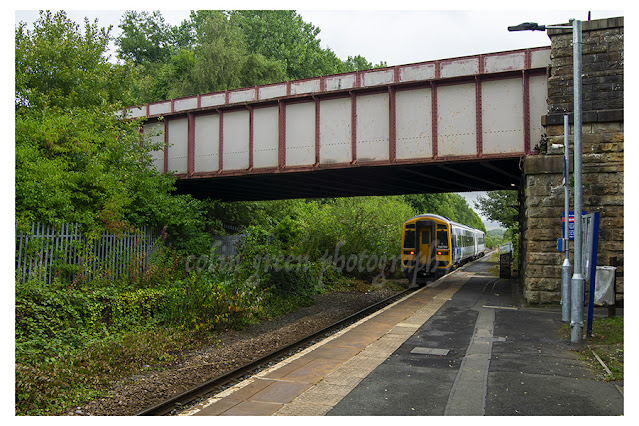
The station looking west from the end of the platform. Despite Junction Street Bridge (Foreground)
and Padiham Road Bridge (Background) passing over the station, the 2 platforms were connected
by a wooden passenger bridge sighted between the 2. I assume this was removed when the line
was singled in the 1980's, but it may have been earlier as there is evidence on another site entrance
just off Junction Street Bridge.


The station looking eastward (towards Colne) from the end of the platform. The stations only
facilities are the shelter seen before the bridge and a ticket machine to my right
just out of shot.

Please take a moment to share this post, follow me on social media, and explore my work on Clickasnap and Photo4Me using the links below. Your support means a lot!


All the pictures remain the copyright of Colin Green.

From Cooper Bridge to Brighouse on the Calder & Hebble

 The Calder & Hebble Navigation isn't just a stretch of water; it's a living timeline, carving its way through the heart of Wes...