Showing posts with label 2022. Show all posts

Tuesday, 24 December 2024

Exploring the Past and Present of Lealholm Railway Station

An idyllic stop along the scenic Esk Valley Line, Lealholm Railway Station offers a glimpse into a bygone era of railway travel, all while remaining a crucial link for the local community. It's a place where history, nature, and modern transport intertwine.

A Glimpse into the Past

Lealholm Railway Station opened in 1865, a testament to the ambitious expansion of the railway network in the 19th century. Originally constructed by the North Eastern Railway Company, the station was a key part of the Esk Valley Line, which connected the industrial hub of Middlesbrough to the coastal resort of Whitby. This line served not only passengers but also the burgeoning freight industry of the region.

The architecture of the station building itself speaks volumes about its heritage. The former station master's house, a sturdy stone building with prominent chimneys, now serves as a private residence. This building once housed the booking hall, where travellers would purchase their tickets before boarding. While the station's purpose has evolved, its historical character remains intact.

The Station Today

Lealholm Station, now managed by Northern Trains, is a simpler affair. Passengers wait for their trains in a small, modern waiting area, a functional replacement for the grand booking hall of the past. The station has a fascinating duality: it maintains its historic layout while adapting to contemporary needs.

The station's layout features a passing loop line, a relic of its busier past. This line was once vital for allowing freight trains to pass one another, a feature that still exists today, though it's not as frequently used. You can see the dual tracks curving through the station, a reminder of its former importance. The second platform, once built for infrequent use, has now become largely overgrown, with wildflowers and tall grasses reclaiming the space. This natural reclamation adds to the station's rustic charm.

Connecting Communities

Despite its minimalist facilities, Lealholm is an essential stop for locals and tourists alike. The station provides a vital link for the community, with a reliable, albeit limited, service. On weekdays, the station is served by approximately five trains per day towards Whitby and six trains per day towards Middlesbrough. It's always a good idea to check the schedule, as Sunday services can vary.

Stepping off the train at Lealholm, you're immediately greeted by the peaceful, rural surroundings. The Esk Valley Line is renowned for its scenic journey, and Lealholm is no exception. Surrounded by lush greenery and rolling hills, the station feels like a true escape from the hustle and bustle of city life. The combination of its rich history, its connection to the natural landscape, and its continued role as a community hub makes Lealholm Railway Station a truly special place.


Please take a moment to share this post, and follow me on social media.

All images remain the copyright of Colin Green.

Saturday, 16 November 2024

North Bridge, Halifax

 A Bridge Through Time

North Bridge, a striking Victorian iron and stone structure, stands as a testament to Halifax's rich industrial past. Spanning the River Hebble, this iconic bridge has played a vital role in connecting the town to the wider region for over a century.

A Bridge Reborn

The original stone bridge, built in 1774, met a tragic end in 1855 due to flash flooding. To accommodate the growing needs of the town and the emerging railway network, a new bridge was constructed in the grand Victorian Gothic style. Designed by the Fraser brothers, North Bridge opened in 1871, a feat of engineering that was both beautiful and functional.

A Busy Thoroughfare

For many years, North Bridge bore the weight of heavy traffic, including tram lines that extended across the bridge. However, the increasing demands of modern transportation led to the construction of the Burdock Way flyover in 1973, relieving the bridge of much of its burden.

A Lasting Legacy

Despite the passage of time, North Bridge continues to be an integral part of Halifax's identity. Its elegant architecture and historical significance make it a popular landmark for both locals and visitors. As we walk across this magnificent structure, we can't help but marvel at the ingenuity and craftsmanship of those who built it.

The pictures below were taken with Nikon d3300 on the 3rd July 2022.


Please take a moment to share this post, and follow me on social media.

All the images remain the copyright of Colin Green.

Saturday, 17 August 2024

Bolling Hall: A Glimpse into Bradford's Past.

Nestled in the heart of Bradford, Bolling Hall stands as a testament to the city's rich history. This magnificent Grade I listed manor house, with its origins dating back to the 13th century, offers visitors a captivating journey through time.

A Brief History

Bolling Hall has witnessed centuries of change. It has served as a family home, a stronghold during the English Civil War,and a symbol of the industrial revolution. The hall's architecture reflects its evolution, with elements of medieval, Tudor,Georgian, and Victorian styles.

Exploring the Hall

A visit to Bolling Hall is a delightful exploration. Wander through the beautifully preserved period rooms, each offering a glimpse into different eras. Admire the intricate details, from the ornate fireplaces to the antique furnishings.

Highlights include:

  • The Great Hall: A spacious and impressive room with a stunning inglenook fireplace.
  • The Victorian Kitchen: Step back in time and experience the challenges of Victorian domestic life.
  • The Servants' Quarters: Discover the lives of the people who worked behind the scenes.
  • The Gardens: Enjoy a peaceful stroll through the beautifully landscaped gardens.

Events and Activities

Bolling Hall regularly hosts a variety of events and activities, making it a great destination for families and history enthusiasts. From exhibitions and workshops to themed events and live performances, there's always something to discover.

A Must-Visit for History Lovers

If you're looking for a fascinating and educational experience, Bolling Hall is a must-visit. With its rich history, stunning architecture, and engaging exhibits, it's a captivating destination that offers something for everyone.

The pictures I took were in the gardens, they show the magnificent of the hall on a cool December morning. They were taken using a Nikon d3300 on the 10th December 2022.


Please take a moment to share this post, and follow me on social media.

All the images remain the copyright of Colin Green.

Saturday, 23 March 2024

Long Preston Railway Station: A Stop on the Scenic Bentham Line

Nestled in the heart of North Yorkshire, Long Preston isn't your grand city station. But for those seeking a taste of rural England and a gateway to the Yorkshire Dales, it holds a certain charm.

Located on the scenic Bentham Line, which winds its way between Leeds and Morecambe via Skipton, Long Preston offers a peaceful escape. The original station buildings are long gone, replaced by basic shelters on each platform. But don't be fooled by its simplicity; there's a certain romance in its lack of modern frills.

For train enthusiasts, Long Preston holds particular significance. It's the last station before the Bentham Line and the Settle-Carlisle Line diverge. The Settle-Carlisle is known for its breath taking views and challenging engineering feats, making it a favourite among railway fans.

While the station itself is unstaffed, a handy ticket machine was installed in 2019, allowing for convenient ticket purchases. There's also a small car park for those arriving by car.

Long Preston's beauty lies in its surroundings. The village itself is a quintessential Yorkshire Dales gem, with old stone houses and traditional pubs. Stepping off the train, you're instantly transported into a world of peace and tranquillity.

For those seeking adventure, the Yorkshire Dales National Park beckons. With its rolling hills, dramatic waterfalls, and charming villages, it's a walker's paradise. Buses depart regularly from the station for the nearby towns of Settle and Skipton, offering further options for exploration.

Long Preston station sees a modest number of trains each day, with services running to Leeds, Morecambe, and Carlisle. To ensure a smooth journey, it's wise to check timetables in advance, especially if you're connecting to other routes.

While the station may lack extensive facilities, its basic amenities and idyllic location make it a worthwhile stop.  If you're looking for a taste of rural England and a gateway to the Yorkshire Dales, Long Preston Station awaits.

The pictures below were taken with a Nikon d3300 on the 19th August 2022.


Please take a moment to share this post, and follow me on social media.

All the images remain the copyright of Colin Green.

Saturday, 16 March 2024

Beggar's Bridge, Glaisdale, North Yorkshire

Nestled in the picturesque village of Glaisdale, nestled within the North York Moors National Park, lies a bridge steeped in history and romance, Beggar's Bridge. This graceful, single-arched structure, built in 1619, is more than just a passage over the River Esk; it's a testament to enduring love and the determination of a man named Thomas Ferris.

Legend has it that Ferris, the son of a humble farmer, fell head over heels for Agnes Richardson, the daughter of a wealthy squire from across the river. When Ferris sought her hand in marriage, he was scorned by Agnes' father and deemed a mere "beggar." Undeterred, Ferris vowed to make his fortune and prove his worth.

He set sail for the Caribbean, where he amassed wealth. Upon his return, his heart still belonged to Agnes. But fate seemed to have other plans. A raging flood made the river impassable, preventing him from reaching his love. Filled with despair but resolute, Ferris made a promise: he would build a bridge at that very spot so no one would ever be separated by the Esk's waters again.

And so Beggar's Bridge came to be. Today, it stands as a symbol of unwavering love and perseverance. The bridge itself is a beauty to behold, a single elegant arch constructed from time-worn stone. It's a Grade II* listed structure, recognised for its historical and architectural significance.

Beggar's Bridge is a popular stop for visitors to Glaisdale. Whether you're a history buff, a hopeless romantic, or simply an admirer of beautiful architecture, this bridge has something to offer. Take a moment to stand on its sturdy stones and imagine the stories it whispers of love, loss, and the enduring human spirit.

Here are some additional tips for your visit:

  • Location: Beggar's Bridge is situated on the eastern outskirts of Glaisdale village.
  • Accessibility: While the bridge itself is easily accessible, the terrain around the river might be uneven. Be sure to wear sturdy shoes.
  • Combine your visit: The bridge lies close to the Coast to Coast path, a popular hiking route. Make a day of it and explore the surrounding countryside.
  • Local legend: Keep an eye out for informative plaques near the bridge that tell the tale of Thomas Ferris and Agnes Richardson.

Beggar's Bridge is a reminder that even the most formidable obstacles can be overcome by the power of love and determination. So, the next time you find yourself in the North York Moors, take a moment to visit this enchanting bridge and soak in its rich history and timeless charm.

The pictures below were taken around the bridge on the 27th August 2022.


The River Esk flowing under Beggar's Bridge, the modern replacement traffic bridge visible just beyond the arch.

The Three Bridges at Glaisdale. In this picture can be seen Beggar's Bridge, it's modern road replacement is just visible to the right of the picture, and the Esk Valley Railway viaduct can be seen at the at the back of the picture.


Please take a moment to share this post, and follow me on social media.

All the images remain the copyright of Colin Green

Wednesday, 27 December 2023

An Urban Escape on the Rochdale Canal

The Rochdale Canal offers a peaceful, flat, and easy walk, even through the urban sprawl of Sowerby Bridge. This 1-mile stretch from Rose Grove Bridge (3) to Tower Hill Bridge (1A) is a perfect escape, taking you through some of the canal's most interesting features.


From Rose Grove to the Tunnel

Our journey begins at Rose Grove Bridge, a classic stone-arched bridge that feels a world away from the town's bustle. The path is a tranquil, tree-lined track with the canal running alongside. The water here is calm, reflecting the trees and sky beautifully, creating a sense of peace. As you walk, you'll hear the gentle sounds of nature and the lapping of water, a calming soundtrack for your stroll.


The Hollins Tunnel

After a short walk, the path leads to the Hollins Tunnel, also known as the Cemetery Tunnel. This is an incredible sight, with its moss-covered stone archway providing a dramatic entrance. The tunnel is a feat of engineering, and a walk through it feels like stepping back in time. The reflection of the tunnel's mouth on the still water inside is a remarkable sight, highlighting the symmetry and craftsmanship of its construction.


The Final Stretch

Once you emerge from the tunnel, the canal curves towards Sowerby Bridge. The path becomes more open, offering glimpses of the town's historic buildings and the impressive hillside landscape. You'll pass under the Co-Op Bridge, an old railway bridge with a modern twist, and finally, arrive at Tower Hill Bridge (1A).

This final section is especially interesting as it marks a point of historical change. The Rochdale Canal, once a bustling commercial waterway, was infilled here in 1952. The waterway was effectively cut off at Tower Hill Bridge, and this part of the canal now connects to the Tuel Lane Tunnel, which opened as part of the canal's restoration. This restoration and reconnection of the Rochdale Canal have allowed this scenic path to be enjoyed by walkers and nature lovers once again.

These two pictures show both sides of Bridge 3 High Royd.


These two pictures show the stretch of Canal towpath between Rose Grove, High Royd Bridge and Hollins Tunnel.


Inside Hollins Tunnel.

Hollins Tunnel entrance on the Sowerby Bridge side.

The canal curbing towards Sowerby Bridge, the Co-Op bridge visible crossing over the canal. The bridge provides access to Hollins Mill Lane from the Industrial Road area of Sowerby Bridge, but does not give any access to the canal.

The canal underneath Bridge 1A. In 1952 the canal was infilled from just beyond the arch, the bridge was also known as Tuel Lane Bridge until the road that crossed over it was rerouted and then it was changed to Tower Hill Bridge. The tower block is Ladstone Towers, built when large areas of low quality housing around the area was demolished in the mid 1960's.

Please take a moment to share this post, and follow me on social media.

All the pictures remain the copyright of Colin Green.

Saturday, 11 November 2023

A British Icon in a Winter Setting: The Morris Minor 1000

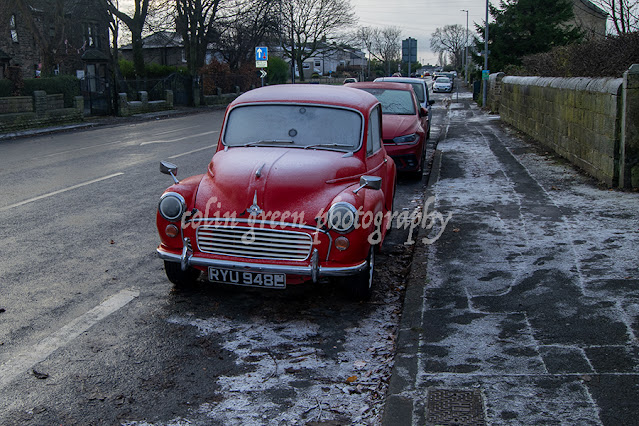
On a frosty December day in 2022, a charming piece of British motoring history was spotted, standing out brightly against the muted, wintery landscape of Bradford. A classic 1967 Morris Minor 1000, its vibrant red paint dusted with frost, was parked outside St. John the Evangelist Church on Bierley Lane, its timeless design a stark and beautiful contrast to the modern cars around it.

A Car of the People

The Morris Minor 1000 is a true British icon. It was in production for a remarkable 15 years, from 1956 to 1971, during which time an astonishing 850,000 models were built. The car was beloved for its simple, sturdy design and its reliable performance, becoming a staple of British roads and a symbol of post-war ingenuity. The photographs capture the essence of this beloved vehicle, from its distinctive curved silhouette to its compact size. The frost on the windscreen and the light snow on the pavement add a touch of nostalgic, seasonal magic to the scene.

A Moment in Time

The pictures, taken with a Nikon D3300, show the car from different angles, highlighting its unique features. From the front, its rounded headlights and classic chrome grille are prominent, while the side-view shot shows its smooth, aerodynamic lines and the distinctive hubcaps. The car's license plate, a vintage "RYU 948E," confirms its 1967 model year, a detail that adds to its historical authenticity.

The backdrop of the church and its graveyard adds a sense of place and permanence to the photographs. The car, a temporary visitor in this historic setting, creates a fascinating juxtaposition between the transient nature of everyday life and the enduring presence of architectural heritage.

The Morris Minor 1000 is more than just a car; it's a cultural artifact. It represents a simpler time and a distinct period in British manufacturing. To see one in such a pristine condition, still on the roads and clearly cherished by its owner, is a delight. It’s a testament to a design that has transcended time, continuing to turn heads and spark memories, even on the coldest of winter days.


Please take a moment to share this post, follow me on social media.

All the pictures remain the copyright of Colin Green.

Saturday, 30 September 2023

A Quiet Echo of a Bygone Era: A Visit to Burnley Rose Grove Railway Station

Stepping onto the platform at Burnley Rose Grove railway station, you're not just arriving at a stop on the East Lancashire Line; you're stepping into a quiet echo of a bygone era. On a late summer day, the 19th of August 2022, I took my camera, a trusty Nikon D3300, to capture a station that, in many ways, tells a story of the ebb and flow of Britain's industrial past.

Burnley Rose Grove, which opened on September 18, 1848, was once a bustling hub, far grander than its current, minimalist form suggests. It was built to serve not only the Rose Grove suburb but also the nearby town of Padiham. The station's importance truly blossomed with the opening of the Great Harwood Loop, also known as the North Lancashire Loop, in 1875. This new line, connecting Rose Grove to Padiham and beyond, cemented the station's role as a vital link in the local rail network.

Looking at the station today, it’s hard to imagine the volume of activity that once took place here. The images I captured from the metal staircase leading down to the platforms giving a sense of the station's compact, functional nature. The blue metalwork of the bridge and stairs, though stark, serves as the main access point, a testament to the station's lack of disabled access and its simple, no-frills character.

The platforms themselves are a study in modern railway minimalism. A small shelter provides some cover from the Lancashire rain, and a few metal benches offer a place to rest. Information boards, like the one with "East Lancashire Line" proudly displayed, offer a connection to the wider rail network, but there are no cafes, no toilets, and no staff—a far cry from the station's heyday when it was a hive of activity.

The railway's story here is a familiar one. Passenger numbers began to decline between the two world wars, and the goods traffic that had sustained the station for so long started its own descent in the 1960s. The coal and oil trains, which once served the nearby power stations, made their last journeys in the late 1980s and early 1990s. The station's fate was sealed. The Great Harwood Loop closed in 1964, and the goods yard soon followed, much of it now buried beneath the concrete sprawl of the M65 motorway. By the early 1980s, the station buildings were gone, and the staff were withdrawn, leaving behind the stripped-down, essential stop we see today.

One of the most poignant scenes I captured was of the disused and overgrown rail track. Parallel to the active line, this track is a physical remnant of the station's past, swallowed up by nature. It's a powerful visual metaphor for a railway that has shrunk but not disappeared. The tracks that remain still serve a crucial purpose, splitting to the east with the East Lancashire Line continuing to Colne and the Caldervale Line heading towards Hebden Bridge and Todmorden.

Burnley Rose Grove is a junction, but it is also a quiet monument to a different time. It stands as a reminder that not all progress is about expansion and growth; sometimes, it's about finding a new, more modest purpose. For those who appreciate the subtle beauty of industrial heritage and the quiet narratives woven into our landscape, a visit to Burnley Rose Grove offers a moment of reflection—a chance to stand in a place where the past and present meet on parallel lines, one active and one reclaimed by the wild.

The only way to access the station is a steep metal staircase, a daunting climb that immediately highlights the lack of accessibility for disabled passengers or anyone with mobility issues. As you ascend or descend, you're faced with what I recall as 34 steps—a challenging number for anyone burdened with luggage or a pram.

This humble station bears little resemblance to its former glory. The center of the platform, now a wide, empty space, was once home to solid stone buildings. It's almost impossible to visualize the vast network of tracks that once existed here; I'm told there were two additional bay platforms and at least eight lines crisscrossing the area.

To the left of the main platform, where the overgrown goods yard once lay, a secret remains. I was later informed that the original bay platforms are still there, hidden from view, tucked away by the dense tree line on either side of the picture. They are a silent testament to a time when this station was a central hub of industry and transit.


Platform 2 occupies this southern side of the bay platform, Trains towards Hapton, Accrington and Blackburn can be caught here. Again the station's only access, the stairs can be seen.

Platform 2.

Overgrown and abandoned track bed viewed from Platform 1. I have been told that there was a bay platform where the trees are.

The island platform from the end of 1.

The opposite end of Platform 1, the sum total of the stations facilities on show, an info board, shelter and bench seats.

Please take a moment to share this post, and follow me on social media.

All the pictures remain the copyright of Colin Green.

Sunday, 24 September 2023

A Frosty Morning's Embrace: Bridging Bradford's Landscape

There's a unique stillness to an early winter morning, especially one touched by frost. This image, captured on the 10th of December, 2022, perfectly encapsulates that quiet beauty. It's a view from a pedestrian bridge that gracefully arches over the A650 Wakefield Road dual carriageway, connecting the Sticker Lane and Dudley Hill areas of Bradford.

The photograph, taken with a Nikon D3300, tells a story of dawn breaking on a truly cold day. The path across the bridge is dusted with a delicate layer of frost, sparkling faintly in the nascent light. Each tiny ice crystal reflects the low, golden rays of the rising sun, creating a natural shimmer that contrasts beautifully with the dark, heavy clouds still clinging to the sky.

The railings, a mix of dark metal and a warmer, almost ochre tone on the brickwork at either end, frame the frosty expanse. Beyond the bridge, the trees stand bare and skeletal against the horizon, characteristic of winter's grip. Yet, there's a promise of warmth in the subtle glow that hints at the sun's eventual triumph over the morning chill.

This isn't just a bridge; it's a silent witness to countless commutes, daily strolls, and moments of quiet contemplation. On this particular morning, it offered a brief, picturesque interlude, a moment of stark beauty before the day's hustle truly began. It's a reminder that even in the most functional parts of our urban landscape, nature still finds a way to paint a breath taking scene.

Next time you're out on a frosty morning, take a moment. You might just find a similar, unexpected beauty right in your path.


Please take a moment to share this post, and follow me on social media.

The picture remains the copyright of Colin Green.

Saturday, 9 September 2023

Valley Parade: A Stadium Forged by History and Resilience

Valley Parade, a name that evokes a deep sense of pride and a poignant memory for many, stands as the home of Bradford City AFC in the Manningham district of Bradford. This stadium is more than just a football ground; it's a monument to the city's rich sporting history and an enduring symbol of resilience in the face of tragedy.


A Century of Sporting Heritage

The stadium's history stretches back to 1886, when it was built on the site of a quarry as the home of Manningham FC, the first champions of the Northern Union (rugby league). Bradford City took up residence in 1903, and since then, Valley Parade has also hosted other teams, including Bradford (Park Avenue) and Bradford Bulls RLFC, cementing its status as a central pillar of West Yorkshire's sporting community.

The stadium itself has undergone many transformations. Until 1952, it was largely unchanged from its early days, but a major structural fault in the Midland Road Stand led to its demolition. For a time, Valley Parade was a three-sided ground until the new East Stand was finally completed in 1966. The pictures from December 2022 show the modern, all-seater stadium, a far cry from its earlier iterations.


Remembering the Tragedy of 1985

On May 11, 1985, Valley Parade was the scene of one of the worst disasters in the history of sport. A fire swept through the wooden structure of the Main Stand (now the JCT 600 Stand), a tragedy that claimed the lives of 56 people and injured 265 others. This event forever changed the stadium and the community.

In the years following the disaster, the stadium was completely rebuilt from the ground up. Today, it stands as a state-of-the-art, all-seater stadium with a capacity of 25,136, spread across five distinct stands, including the Main Stand which was rebuilt to modern safety standards. The new stadium is not just a place for sport; it is a powerful memorial to those who lost their lives, a testament to the community's strength, and a symbol of hope and renewal.

The Main (West) Stand


The JCT 600 Stand, or the Main Stand, is the centerpiece of Valley Parade, a structure with a unique and defining presence. It's the largest stand in the stadium, with a capacity for 9,004 fans, yet it's distinctive for not stretching the full length of the pitch. Instead, the stand occupies just three-quarters of the pitch-side space, with offices filling the remaining quarter. This design gives the stand a unique visual character and creates a natural boundary between the roaring crowd and the administrative heart of the club.

In a small, open section near the offices, a patch of uncovered seating offers a different kind of matchday experience, exposed to the elements. This slight quirk in the design adds to the stand's charm, making it a truly unique feature of the iconic stadium.

The Midland Road (East) Stand

The Midland Road Stand at Bradford's Valley Parade is more than just a single tier of seating; it's a testament to the club's past and the ambition of a former era. With a capacity of 4,500, this stand is a familiar sight to fans, particularly as it's the section used to house away supporters.

Around the turn of the millennium, former chairman Geoffrey Richmond envisioned a far grander future for this part of the stadium. His ambitious plan was to add a second tier, which would have increased the East Stand's capacity to a remarkable 10,000. This project, a symbol of the club's high hopes, never came to fruition. Despite this, the stand remains a crucial part of Valley Parade's identity, a place where rival fans gather to create a vibrant atmosphere and add to the rich tapestry of the matchday experience.

The Kop


This picture perfectly captures the unique character of traditional British football stadiums. Unlike modern, out-of-town arenas, Valley Parade is deeply woven into the fabric of its community. The image shows the Kop Stand rising dramatically over the terraced houses of Rear Rock Terrace, a powerful reminder that the stadium is part of the neighbourhood, not separate from it.

The stadium’s distinctive, asymmetrical shape is a result of this close relationship. Local folklore says the odd angle of the main stand is a direct consequence of the "right to light" laws, which prevented major development from casting a shadow over the homes to the east. This isn’t just a stadium; it’s an urban fortress, built in harmony with the houses that have stood watch over it for generations, a true symbol of football's place at the heart of the community.


The Kop Stand is more than just a place to watch a match—it’s a powerful symbol of fan passion. As the second largest stand in the stadium, with a capacity for 7,492 supporters, it's a vibrant heart of the club. What makes this Kop particularly unique is its design: unlike the traditional, single-tiered Kop stands found in many British stadiums, this one rises in a distinctive two-tiered structure, a modern twist on a classic footballing tradition.

TL Dallas (South) Stand

While the other stands at Valley Parade rise majestically, the TL Dallas South Stand holds its own with a distinct, compact character. Tucked in by Holywell Ash Lane, this two-tiered stand is the smallest in the stadium, with a capacity of 1,840. Despite its size, it’s a crucial part of the ground's atmosphere, as it traditionally houses the away fans. This unique role, combined with its intimate scale and the physical limitations on its expansion, makes the South Stand a a small but vital part of the stadium's story.

Please take a moment to share this post, and follow me on social media.

All the images remain the copyright of Colin Green.