Showing posts with label Outdoors. Show all posts

Tuesday, 10 February 2026

Ending the Year on a High: A New Year’s Eve Trek to Stoodley Pike

Date: December 31, 2016 Location: Todmorden, West Yorkshire Camera: Nikon D3300

There are few better ways to say goodbye to an old year than by climbing above the noise of daily life and standing on top of the world—or at least, on top of the Calder Valley.

On New Year's Eve, 2016, I took my Nikon D3300 up the muddy tracks to one of West Yorkshire’s most iconic landmarks: Stoodley Pike Monument. The air was biting, the light was fading into a winter gloaming, and the moors were silent.

Join me on a walk to the "Sentinel of the Valley."

The Ascent

The climb up to Stoodley Pike is never a casual stroll, especially in the depths of winter. The Pennine Way crosses here, and the path is well-trodden by centuries of boots. As I made my way up, the winter light began to shift, turning the rough moorland grass into a sea of rusted gold.

The approach. The muddy tracks leading the eye straight to the obelisk, standing solitary against the grey winter sky.

There is a stark beauty to the moors in December. The Nikon D3300 did a fantastic job capturing the texture of the dry grasses and the heavy, cloud-laden sky. It felt like the weather was holding its breath, waiting for the year to turn.

A View of Todmorden

As you gain elevation, the town of Todmorden falls away beneath you. One of my favourite shots from the day was looking back down into the valley..

The view from the heights. You can just see the streetlights and house lights flickering on in Todmorden, warm specs of amber against the cooling blue of the hills.

This image captures the isolation of the Pike. Down there, people were likely preparing for New Year's Eve parties, warming their homes. Up here, it was just the wind and the sheep.

The Peace Monument

Standing at 121 feet (37 meters) tall, Stoodley Pike Monument is imposing up close. Interestingly, the structure we see today is actually the second monument on this site. The first, built in 1814 to commemorate the defeat of Napoleon, collapsed in 1854 after a lightning strike and decades of weathering. The current structure was completed in 1856, built to mark the end of the Crimean War.

The monument framed by the rugged gritstone boulders that litter the summit.

Standing tall. The darkening stonework contrasts sharply with the pale winter sky, emphasizing the monument's brooding presence.

It is a structure born of war, yet built for peace, standing guard over the valley for over 160 years.

Into the Darkness

Unlike many follies and monuments that are sealed off, Stoodley Pike invites you in. The entrance is a small, dark opening at the base that leads to a spiral staircase. There are no windows on the way up—it is a pitch-black ascent (a torch or phone light is highly recommended!) that eventually opens up onto a balcony.

The heavy stone base and the entrance. The massive blocks of stone give you a sense of the engineering required to keep this standing against the fierce Pennine winds.

The Balcony View

Stepping out onto the balcony is a visceral experience. The wind usually hits you with renewed force, but the view is worth it. You are standing some 1,300 feet above sea level.

Looking out from the balcony. The weathered stone railing, carved with the initials of visitors from decades past, overlooks the vast expanse of the moorland plateau.

Final Reflections

As the light finally gave way, I captured a silhouette of the monument. It felt like a fitting end to the photo walk—a strong, enduring shape against the fading light of 2016.

The silhouette of the Pike. A simple, powerful geometry against the morning sky.

Visiting Stoodley Pike is a reminder of the permanence of the landscape compared to the fleeting nature of our years. If you find yourself in West Yorkshire, pack your boots and your camera. The hike is steep, but the perspective it offers is unmatched.

Please take a moment to share this post, follow me on social media, and explore my work on Clickasnap and Photo4Me using the links below. Your support means a lot!


All the images remain the copyright of Colin Green.

Friday, 6 February 2026

Chasing Winter Light: A Sunday Stroll in Sowerby Bridge

 Date: December 1, 2019 Location: Sowerby Bridge, West Yorkshire Gear: Nikon D3300

There is something uniquely crisp about the first day of December. It marks the meteorological start of winter, where the light sits lower in the sky, the shadows stretch longer, and the air bites just enough to make you walk a little faster.

Back in 2019, I took my Nikon D3300 out for a Sunday wander through Sowerby Bridge. This corner of the Calder Valley is a photographer's playground, offering a perfect triad of subjects: the industrial stillness of the Rochdale Canal, the raw power of the River Calder, and the skeletal beauty of Dixon Scar Woods.

Join me on a walk through the frost and the history of West Yorkshire.

The Glassy Stillness of the Cut

The walk began on the towpath of the Rochdale Canal. One of the joys of canal photography in winter is the lack of boat traffic, which turns the water into a near-perfect mirror. The greenery of summer has faded, revealing the structural "bones" of the landscape—the stone walls and the bare branches.

The long view along the Rochdale Canal. The blue sky reflects perfectly in the water, creating a peaceful, leading line through the valley.

Moving closer to the town centre, the relationship between the waterway and the industrial heritage becomes clearer. Sowerby Bridge was built on wool and engineering, and the old mills still tower over the water.

Where industry meets leisure. A boat sits quietly moored beneath the towering stone walls of the converted mills.

Crossing the Canal

Crossing over the Rochdale Canal, I headed toward the River Calder. Unlike the man-made tranquillity of the canal, the river is untamed and energetic. To get there, you often have to traverse the old infrastructure that stitches this town together.

I’ve always had a soft spot for the "Co-Op Bridge." It isn’t pretty in the conventional sense—it’s rusted, covered in graffiti, and utilitarian—but it has character. It frames the transition from the urban streets to the wilder woods perfectly.

The texture of the city. The rusted iron lattice and stone steps of the Co-Op Bridge provide a gritty contrast to the nature that surrounds it.

The Roar of Hollins Mill

Just downstream, the sound of water dominates the air. The weir at Hollins Mill is a reminder of the power that once drove the industry here. Even on a calm day, the water rushes over the stone steps with impressive force.

A wide view of Hollins Mill Weir. You can see how the houses cling to the hillside, overlooking the tumbling water.

I spent some time here playing with the shutter speed on the Nikon D3300 to capture the movement of the water crashing over the historic stonework.

The power of the Calder. The intricate stonework of the weir breaks the water into white foam as it heads downstream.

Into Dixon Scar Woods

Crossing the river leads you into Dixon Scar Woods. This area feels ancient, especially in winter. The leaves had mostly fallen, carpeting the floor in varying shades of brown and gold, allowing the low winter sun to pierce through the canopy in spectacular fashion.

Looking back at the river from the edge of the woods. The mossy trees dip their branches into the cold, blue water.

The highlight of the walk, however, was the light in the clearing. The sun was positioned just behind the tree line on the ridge, creating a stunning "starburst" effect that illuminated the frosty mist clinging to the meadow. It was one of those moments you have to be quick to capture before the clouds shift.

The golden hour strikes at midday. A perfect sunburst through the trees illuminates the frosty grass and a dog enjoying a morning run.

The quiet meadow. The frost lingers in the shadows of the valley floor, creating a cool, textured foreground against the wooded hill.

Final Thoughts

Looking back at these photos from 2019, I'm reminded that you don't need to travel far to find beautiful landscapes. Sowerby Bridge offers a density of photographic opportunities—from gritty industrial textures to ethereal woodland light—all within a mile's walk.

If you ever find yourself in West Yorkshire on a crisp winter day, take a walk down the cut and into the woods. Just don't forget your camera.

Please take a moment to share this post, follow me on social media, and explore my work on Clickasnap and Photo4Me using the links below. Your support means a lot!


All the images remain the copyright of Colin Green.

Sunday, 14 April 2024

Welcome to St. Luke's: Norland's Friendly Village Church

Nestled in the heart of Norland village sits the charming little church known as St. Luke's. More than just a place of worship, St. Luke's boasts a rich history and serves as a vibrant hub for the local community.

St. Luke's was opened in April 1866 at a cost of approx. £900. The Rev. John Ellison was instrumental in the decision to build what was then a Chapel of Ease for Christ Church in Sowerby Bridge. This quaint stone building, occupying a central position in the village has stood witness to the changing times of Norland. Early photographs depict a more rural setting, with the church surrounded by open fields.

St. Luke's welcomes everyone with open arms. Their website describes them as a "small and friendly church, and their commitment to inclusivity shines through. They hold services every Sunday afternoon, with an additional morning prayer on Mondays.

Stepping beyond traditional services, St. Luke's plays an active role in the community. Their website highlights a close relationship with the nearby Norland CE School. They also host the Hub cafe, a wonderful space for people to connect and socialise. Additionally, they hold various events throughout the year, fostering a strong sense of community spirit.

Whether you're a local resident or simply curious about this historic church, St. Luke's offers several ways to get involved, with information easily available on their website.

So, if you're ever in the Sowerby Bridge area, take a moment to visit the charming little church on the hill. You might just discover a welcoming community and a beautiful piece of Norland's history.

The pictures below were taken on the 24th February 2024 with a Nikon d3300. Clicking any of them should open a link in another window to my Colin Green Photography store on Zazzle.

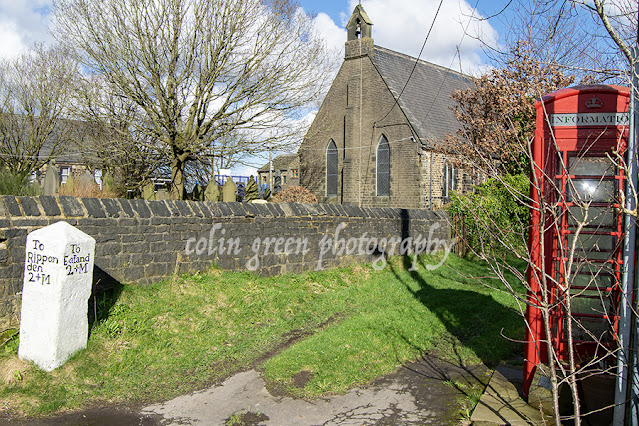
The church occupies a position at a cross roads in the centre of the village. The mileage marker showing the distance to Ripponden and Elland. The former phone box is now used as a village information point.

The south eastern corner of St Luke's, the war grave visible is the final resting place of Private Charles Albert Lumb, he served in the West Yorkshire Regiment until his death on the 21st August 1942 at the age of 28. He had been Married to Stella for just 4 years. His father had died at Ypres in October 1917.

Rusty gate at the eastern entrance to the churchyard. Private Lumb's headstone place again visible.


The church western gate is found opposite Norland Church of England Junior and Infant School.

Please take a moment to share this post, follow me on social media, and explore my work on Clickasnap and Photo4Me using the links below. Your support means a lot!


All the pictures remain the copyright of Colin Green.

The Salvage Archive: Langthwaite in 1976 through a 35mm Lens

 There is a unique kind of magic hidden within the emulsion of a 35mm slide. When held up to the light, these tiny windows into history offe...