Showing posts with label Sylvia Plath. Show all posts

Saturday, 4 October 2025

Heptonstall and the Old Grammar School

On a grey, autumnal day in November 2013, a Samsung Galaxy tablet captured a series of images that perfectly encapsulate the enduring charm and rich history of Heptonstall, a village perched on the hills above Hebden Bridge in West Yorkshire. The subject of these photos, the Heptonstall Museum, is more than just a building; it's a Grade II-listed testament to centuries of change, a cornerstone of a community steeped in history.

The building that now houses the museum has had a fascinating journey through time. Its origins trace back to around 1600, when it was constructed not as a place of learning, but as a warehouse. This was a time when the woollen trade was the lifeblood of the Pennines, and Heptonstall was a bustling centre for handloom weaving. You can still see hints of this industrial past in the large first-floor windows of many local cottages, designed to maximise the light for the weavers working within.

In 1771, the building was given a new purpose when it was converted into the Heptonstall Grammar School. The photos from 2013 show the solid stone structure and classic architecture, elements that have witnessed generations of students passing through its doors. The school served the community until its closure in 1889. While the modern world moved on, the building's story didn't end there. For a time, it housed the Yorkshire Penny Bank, before finally reopening its doors in August 1972 as the Heptonstall Museum.

The museum today is a treasure trove of local history, offering a window into the past. It tells the story of the village's prehistoric beginnings and its role in significant events, including the Battle of Heptonstall during the English Civil War in 1643. One of the most captivating exhibits delves into the notorious Cragg Vale Coiners, a gang of counterfeiters who plagued the area in the 18th century. Their leader, "King" David Hartley, is buried in the nearby churchyard—one of the many historical figures whose stories are woven into the fabric of Heptonstall.

Speaking of the churchyard, it is perhaps one of the most unique in the country. It is home to not one, but two churches. The ruins of the Church of St Thomas a Becket, founded in the 13th century and severely damaged in a storm in 1847, stand as a hauntingly beautiful shell. Just yards away, the newer St Thomas the Apostle church, built in the 1850s, stands proudly, a symbol of resilience. This dual churchyard is also the final resting place of American poet Sylvia Plath, a poignant connection to the wider literary world.

The Heptonstall Museum, housed in its old grammar school building, serves as a perfect starting point for exploring this remarkable village. It's a place where the past isn't just displayed, it's alive in the very stones of the building and the stories they tell.

Clicking any of the pictures below should open a link in another window to my Colin Green photography store on Zazzle.


Please take a moment to share this post, follow me on social media, and explore my work on Clickasnap and Photo4Me using the links below. Your support means a lot!


All the pictures remain the copyright of Colin Green.

Thursday, 30 December 2021

The Ruined Church of St. Thomas à Becket, Heptonstall

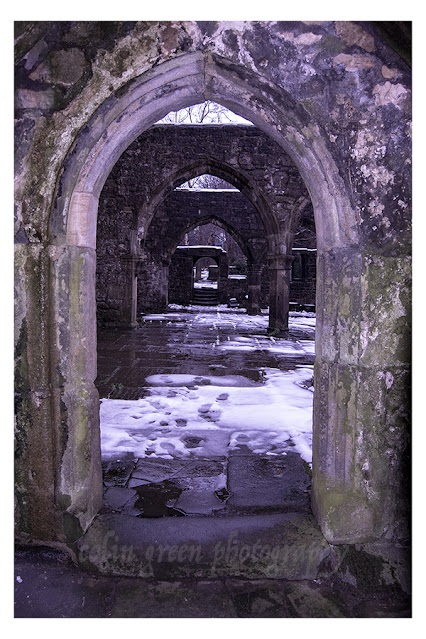
There's something uniquely captivating about ancient ruins, especially when they stand sentinel amidst the everyday. Tucked away in the picturesque village of Heptonstall, nestled in the Upper Calder Valley, are the hauntingly beautiful remains of the original Heptonstall Parish Church, also known as the Church of St. Thomas à Becket, or at times, The Chapel of St Thomas the Martyr. I had the privilege of capturing these atmospheric scenes on a snowy day, November 19th, 2016, with my Nikon D3300.

The images transport you to a place where history whispers from every crumbling stone and frost-kissed archway. You can almost feel the chill wind that must have swept through its open spaces for centuries.

Originally constructed sometime in the late 12th to early 13th Century, this venerable church was a vital hub, serving the communities of Heptonstall, Erringden, Langfield, Stansfield, and Wadsworth. Its priests, appointed and funded by the Vicar of Halifax, ministered to the people living west of Halifax, a testament to its significant role in the spiritual life of the region.

The church's long history wasn't without its dramatic moments. Around the turn of the 16th Century, it was even closed for a period due to the murder of a priest, reportedly after he performed an illicit marriage ceremony – a tale that adds a layer of intriguing mystery to its past. Over the centuries, the church saw numerous renovations and additions, undergoing significant changes in the 14th, 15th, 16th, and 17th centuries. In 1810, a new clock was installed, a detail that now connects it to its successor.

However, fate had a different plan for this ancient structure. In 1847, a devastating storm swept through, tearing off the roof, damaging the tower, and causing considerable havoc in the churchyard. The "church rate," a tax intended to support the parish church, simply wasn't enough to cover the extensive repairs needed.

Rather than restoring the damaged church, the community rallied together through voluntary subscriptions and built a brand new church right in the same churchyard, which officially opened its doors in 1854. This new church stands proudly beside its older, ruined counterpart, a poignant reminder of continuity and change.

Today, the ruins of the Church of St. Thomas à Becket remain, a majestic and poignant landmark. Walking through its snow-dusted nave, beneath its skeletal arches, is a truly evocative experience. It’s remarkable to think that occasionally, outdoor services are still held within these ancient walls, bringing new life to a place steeped in so much history.

These photographs capture the raw beauty and quiet dignity of the ruins, particularly striking against the winter snow. The interplay of light and shadow, the starkness of the stone against the white landscape, and the enduring strength of the remaining structure all tell a story of centuries past.

If you ever find yourself in Heptonstall, I highly recommend a visit to these incredible ruins. They are a powerful testament to time, resilience, and the enduring spirit of community.

Clicking any of the images below should open a link in another window to my Colin Green Photography store on Zazzle.


Please take a moment to share this post, follow me on social media, and explore my work on Clickasnap and Photo4Me using the links below. Your support means a lot!


All the pictures remain the copyright of Colin Green.

Sunday, 5 August 2018

Aspinall Street: Where Ted Hughes Began

Nestled in the heart of Mytholmroyd, West Yorkshire, a seemingly ordinary terraced house holds an extraordinary secret. 1 Aspinall Street, with its unassuming facade, is the birthplace of one of England's most celebrated poets, Ted Hughes. Born on August 17th, 1930, Hughes's early years within these walls, and the wild, dramatic landscape surrounding them, would forever shape his poetic vision.

Imagine a young Ted, his imagination ignited by the rugged beauty of the Calder Valley. The wind whistling through the hills, the dark, brooding moors, the rushing waters of the River Calder – these were the raw materials that would later be forged into the powerful imagery of his poetry. He lived here until he was eight, a formative period that imprinted the very essence of this place onto his soul, even after his family moved to Mexborough, South Yorkshire.

It's fascinating to consider how this small, terraced house, a humble beginning, could nurture such a towering literary figure. The landscape of Mytholmroyd, with its blend of industrial grit and untamed nature, is palpable in Hughes's work. You can almost feel the dampness of the stone, hear the cries of the curlews, and sense the ancient, elemental forces that he so masterfully evoked.

Today, 1 Aspinall Street stands as a testament to Hughes's legacy, thanks to the dedicated work of the Elmet Trust. Established in 2006, the Trust is a passionate advocate for Hughes's life and work. They took on the responsibility of restoring the house, meticulously recreating its 1930s ambiance. In June 2008, their efforts culminated in a beautifully preserved piece of literary history.

But 1 Aspinall Street isn't just a museum piece. It's a living, breathing space, a retreat for writers seeking inspiration in the very place where Hughes's own journey began. Imagine yourself, pen in hand, sitting by the window, gazing out at the same vistas that fuelled his imagination. The very air seems charged with creative energy.

The Elmet Trust has transformed this modest dwelling into a sanctuary, a place where words can flow freely, where the echoes of Hughes's voice can still be heard. It's a reminder that even the most extraordinary journeys often begin in the most ordinary of places.

If you're a writer, a poet, or simply a lover of literature, consider a pilgrimage to 1 Aspinall Street. It's more than just a house; it's a portal to the past, a connection to the roots of a literary giant, and a chance to experience the very landscape that shaped his genius.

Perhaps, within those walls, you too will find your own voice, inspired by the whispers of Aspinall Street.

I took these pictures on the 21st July 2018 with a Nikon d3300, clicking on any of them should open a link in another window to my Colin Green Photography store on Zazzle.


I wanted to add the sepia & black and white versions to age the pictures a little, i felt they gave the photo's a bit more character than the colour versions.

The picture below features a copy of Hughes poem the Harvest Moon, no copyright infringement is intended and I will remove if required.

Thanks for looking and please take a moment to share and follow me on social media, and check out my Portfolio's on Photo4Me and ClickAsnap via the links below.


All pictures remain the copyright of Colin Green.

Great Scots, Part V: The Final Ten—Reformers, Field Marshals, and Polar Pioneers

We've reached the end of our exploration into the captivating 1933 Mitchell's Cigarettes "Great Scots" collection. This f...