Saturday, 11 November 2023

A British Icon in a Winter Setting: The Morris Minor 1000

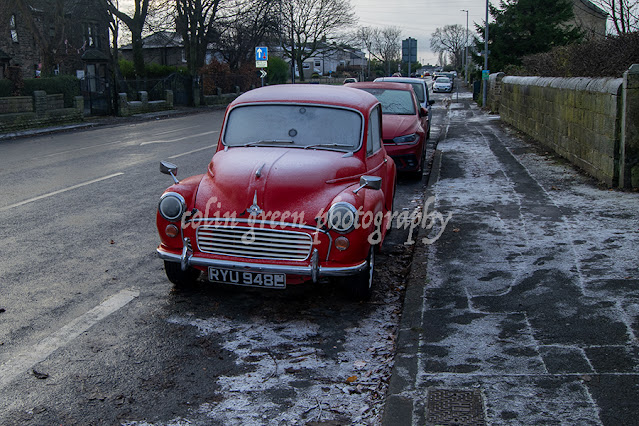
On a frosty December day in 2022, a charming piece of British motoring history was spotted, standing out brightly against the muted, wintery landscape of Bradford. A classic 1967 Morris Minor 1000, its vibrant red paint dusted with frost, was parked outside St. John the Evangelist Church on Bierley Lane, its timeless design a stark and beautiful contrast to the modern cars around it.

A Car of the People

The Morris Minor 1000 is a true British icon. It was in production for a remarkable 15 years, from 1956 to 1971, during which time an astonishing 850,000 models were built. The car was beloved for its simple, sturdy design and its reliable performance, becoming a staple of British roads and a symbol of post-war ingenuity. The photographs capture the essence of this beloved vehicle, from its distinctive curved silhouette to its compact size. The frost on the windscreen and the light snow on the pavement add a touch of nostalgic, seasonal magic to the scene.

A Moment in Time

The pictures, taken with a Nikon D3300, show the car from different angles, highlighting its unique features. From the front, its rounded headlights and classic chrome grille are prominent, while the side-view shot shows its smooth, aerodynamic lines and the distinctive hubcaps. The car's license plate, a vintage "RYU 948E," confirms its 1967 model year, a detail that adds to its historical authenticity.

The backdrop of the church and its graveyard adds a sense of place and permanence to the photographs. The car, a temporary visitor in this historic setting, creates a fascinating juxtaposition between the transient nature of everyday life and the enduring presence of architectural heritage.

The Morris Minor 1000 is more than just a car; it's a cultural artifact. It represents a simpler time and a distinct period in British manufacturing. To see one in such a pristine condition, still on the roads and clearly cherished by its owner, is a delight. It’s a testament to a design that has transcended time, continuing to turn heads and spark memories, even on the coldest of winter days.


Please take a moment to share this post, follow me on social media.

All the pictures remain the copyright of Colin Green.

Saturday, 4 November 2023

Asquith Bottom Mill: A Sowerby Bridge Survivor

The former Asquith Bottom Mill in Sowerby Bridge stands as a powerful testament to the region's industrial past, a hulking monument of brick and stone that has adapted to the changing times. These images, taken in April 2017, capture the mill complex in its current state as a mixed-use industrial estate, a fascinating blend of old and new.

A Legacy of Industry

Asquith Bottom Mill has a rich history, serving various purposes over the years, from a carpet mill to a wire and woollen mill. It was originally built by the Edlestons family, a name that many locals will recall with fondness. For those who grew up in the area during the 1980s, the sight of a vibrant red neon sign bearing the Edlestons name across the roof is a cherished memory, a beacon of a bygone era that has sadly since been removed. The mill's closure in the late 1980s and early 1990s marked the end of a significant chapter for the area.

The photographs from 2017 reveal the sheer scale and character of the mill. The wide-angle shot shows the full facade of the main building, its rows of large, multi-paned windows a classic feature of mill architecture. The lower buildings in the foreground, with cars parked alongside, indicate the complex's modern function, a bustling hub for various businesses.

A Walk Through Time

Walking through the mill complex is like stepping into a living museum. One of the images captures a narrow ginnel or alleyway that runs between two buildings, with an overhead passageway connecting them. This architectural feature, common in industrial complexes of this size, speaks to a time when goods and people needed to move efficiently between different parts of the mill.

The details are what truly tell the story. A photograph of the building's exterior, shot at an upward angle, highlights the patina of age on the stone and the faded, closed-off windows, some of which still have their original frames. Another striking image, a black and white shot with a splash of red, focuses on a set of external stairs. These "red stairs," a pop of colour against the otherwise monochrome backdrop of the brickwork, lead up the side of one of the buildings, a dramatic and eye-catching feature that evokes a sense of both the mill's grand past and its slow, inevitable decline.

Asquith Bottom Mill, much like the surrounding landscape of Sowerby Bridge, is a symbol of resilience. It is a place that has not been forgotten but has been given a new purpose, a place where the echoes of industrial looms and the footsteps of mill workers still linger, even as new businesses thrive within its walls. These photographs serve as a poignant reminder of its past and a celebration of its enduring legacy.

A vibrant memory from the mill's past stands in stark contrast to its present-day industrial hustle. Where the cars now sit parked in front of the mill, there once was a lush bowling green, a green oasis across the River Ryburn. The most striking change, however, was the mill's rooftop. For years, the building was crowned with a brilliant red neon sign that proudly displayed the W.M. Edlestons name—a familiar, glowing landmark that lit up the Sowerby Bridge skyline.

Once, goods and materials were hoisted to and from these doorways, but now, a lone hoist support juts out from the old brickwork, a silent reminder of the mill’s industrious past.


This picture was taken from the Norland hillside towards the back of the building. I don't imagine other than for safety checks that fire escape has been used in many years.
 
 Please take a moment to share this post, and follow me on social media.

All the pictures remain the copyright of Colin Green.

Saturday, 28 October 2023

Washer Lane Aqueduct: A Hidden Relic of Halifax's Industrial Past

Tucked away at the entrance to the Washer Lane Industrial Estate in Halifax, a remarkable piece of local history stands as a silent sentinel. The Washer Lane Aqueduct, built between 1856 and 1873, is a striking relic from the town's booming industrial era. These images, captured on a lush June day in 2023, reveal its unique character and the fascinating story behind it.


A Landmark Built by an Industrialist

The aqueduct was constructed during the period when John Edward Wainhouse owned the Washer Lane Dyeworks. Wainhouse, a prominent figure in Halifax's industrial landscape, is perhaps best known for building the Wainhouse Tower, a flamboyant folly that dominates the local skyline . The aqueduct, while far less ornate, shares a similar connection to his industrial legacy.

The initials "J.E.W." are visible carved into the keystone of the arch, a personal touch that marks the structure as Wainhouse's creation. The aqueduct was originally built to carry water across the access road, a crucial component for the dyeworks which required a constant and clean supply of water for their operations.


A Quiet End to an Era

The dyeworks closed in 1896, and with its closure, the aqueduct's purpose came to an end. It has stood since as a picturesque, if unused, feature of the landscape. Without access to the top of the structure and with limited information available, it's safe to assume that the aqueduct no longer carries water.

Today, the aqueduct spans the top entrance road to the industrial estate, which runs down from Upper Washer Lane. The old cobbled road, flanked by high, moss-covered stone walls, passes directly beneath its stone arch. The entire scene feels like a journey back in time, a quiet corner of the valley where nature is slowly reclaiming the old industrial stonework.

The aqueduct is a hidden gem, a small but significant piece of Halifax's history that reminds us of the ingenuity and ambition of the industrialists who shaped the Calder Valley. It's a testament to a time when water was the lifeblood of industry and a reminder that even the most functional of structures can become a thing of beauty over time.


The initials of John Edward Wainhouse can be seen on the centre stone of the aqueduct. Wainhouse owned the dye works from 1856 when he inherited them until he sold it to Henry Mossman in 1873. Because of the initials I think the aqueduct must date from this 17 year period.


Please take a moment to share this post, and follow me on social media.

All the pictures remain the copyright of Colin Green.

Sunday, 22 October 2023

A Walk in the Rain: Exploring Brearley and the Route 66 Cycleway

There’s a unique beauty to the Calder Valley when it's raining. The greens become richer, the stone walls darker, and the atmosphere takes on a moody, contemplative quality. My recent walk, a loop starting from home in Sowerby Bridge and leading through Boulderclough and Mytholmroyd before returning along the Route 66 cycleway, offered a perfect, if soggy, opportunity to experience this.

The Murder Stone: A Dark Tale on a Pleasant Path

The Route 66 cycleway, is a well-loved trail for cyclists and walkers alike. As you pass through the hamlet of Brearley, just south of the railway bridge, you encounter a fascinating and rather macabre piece of local history: the memorial to William Deighton.

The "murder stone," as it's known, is a solemn reminder of a brutal crime. The memorial commemorates William Deighton, a tax inspector who was killed in Halifax while investigating the notorious coin counterfeiter "King" David Hartley and his gang. The stone, with its weathered, skeletal carving and a fragment of text, stands as a chilling artifact of a time when the law in this part of Yorkshire was a dangerous business. The photographs capture the stone in its atmospheric setting, nestled in the long grass beside the path, a quiet and unexpected monument to a violent past.

The path is part of the Route 66 cycleway (bridleway), with the railway bridge seen at the top of the picture and the green metal wall.

Underneath the skeletal artwork reads the following: A full and true account of a barborous, bloody, and inhuman murder. There is further artwork below this writing.

A Shelter, and a Soaking

Carrying on my walk past the former chapel, now converted into apartments, and through the heart of Brearley, the skies opened up. The rain, which had been threatening all morning, finally began to pour. Seeking shelter, I ducked under the arch of the Wheatley Royd Farm Bridge. It was a temporary reprieve, a dry spot from which I could watch the rain stream down the stone walls of the bridge and form rivulets on the path. The view from under the bridge, a framed shot of the lush, wet greenery beyond, was a beautiful moment of calm.

However, after nearly 30 minutes of waiting, with my weather app stubbornly refusing to offer any hope of a quick clearing, I conceded defeat. The path ahead called, and there was nothing for it but to embrace the inevitable soaking.

The images from the walk, from the striking memorial to the moody, rain-soaked landscapes of the Calder Valley, tell the story of the day perfectly. They capture the unique blend of history, nature, and unexpected weather that makes walking in West Yorkshire such a rewarding experience, even when you end up soaked to the skin.


Please take a moment to share this post, and follow me on social media.

All the pictures remain the copyright of Colin Green.

Saturday, 21 October 2023

Christ Church, Sowerby Bridge: A Winter Wonderland of History

Against a backdrop of snow-dusted hills and a brilliant blue sky, Christ Church in Sowerby Bridge stands as a magnificent sentinel. These images, captured on a crisp March day in 2018, show the church in a rare and beautiful state, its historic stone and Gothic features enhanced by a fresh layer of winter white.

A New Church for a Growing Town

Christ Church's story is one of community spirit and forward-thinking. Built in 1821 by architect John Oates, it was the culmination of over two decades of dedicated fundraising. The growing population of Sowerby Bridge had outstripped the capacity of the old Brigg Chapel, which had served the town since 1526, and a new, larger place of worship was needed.

Despite its completion in 1821, the church's official consecration was delayed until 1824, a small footnote in the grander tale of its creation. The photographs beautifully showcase the church's impressive architecture, from its towering steeple and clock face to the intricate detailing of its windows and buttresses.

A History of Adaptation and Resilience

Christ Church has not remained static since its construction. It has been remodelled, extended, and refurbished multiple times to meet the changing needs of its congregation. A particularly dramatic moment in its history occurred in 1895, when a fire ravaged the chancel, roof, and organ. The church was gutted but not defeated, and the community rallied once again to restore it to its former glory.

Inside, the church holds treasures from other nearby places of worship that have since closed. This practice of repurposing and relocating items speaks to the deep sense of history and continuity within the Anglican faith in this area, ensuring that pieces of the past are not lost but are given a new home and a new purpose.

The Story of the Graveyard

The churchyard has a history all its own. In 1857, the Secretary to Queen Victoria ordered its closure due to public health concerns and fears of disease. Despite this official order, burials are said to have continued for over a century, with the last known burial being John Eddie Bottomley in 1960. The images show the snow-covered landscape of the graveyard, a peaceful and sombre place that holds the final resting places of generations of Sowerby Bridge residents.

The view from above, overlooking the church and the snow-dusted landscape, is particularly striking. It frames Christ Church as a landmark, a prominent feature in the valley that has witnessed the town's evolution from a small settlement into a bustling community.

These photographs, taken with a Nikon d3300, capture not just a building, but a living piece of history. Christ Church, Sowerby Bridge, with its history of fundraising, fire, and resilience, stands as a testament to the enduring spirit of its community, its story etched in stone, and its beauty enhanced by the quiet blanket of a winter's day.

The Rochdale Canal once flowed through the junction pictured, with its church tower overlooking Lock Number 3. However, this section was infilled sometime in the late 1940s or early 1950s, and Tuel Lane was built over it.

The canal was successfully reopened in 1996, but a new approach was needed. A tunnel was constructed underneath the junction, and Locks 3 and 4 were replaced by the deepest canal lock in the United Kingdom, built a short distance to the west of the original Lock 3.


The steps leading up to the church are a recent addition, constructed as part of a road-widening project. The church clock was installed in 1839.


This photo wouldn't have been possible just a few years ago. The view was completely blocked by York House, a block of maisonettes with a poor reputation. The building was torn down around the turn of the millennium, and the area where it once stood is now an overgrown, abandoned plot.

Please take a moment to share this post, and follow me on social media.

All the pictures remain the copyright of Colin Green.